
Hatha, Vinyasa and Ashtanga overlap more than their reputations suggest, but they differ meaningfully in pacing, structure and how sequences are built. No one style is universally better, and the right choice depends on how you prefer to learn and what you want to teach. Some 200-hour trainings specialize in a single style; others are multi-style. Our Amertham program in Bali is a current example of the second approach, working through all three across three weeks.
Quick Answer: What Is the Difference Between Hatha, Vinyasa and Ashtanga?
Hatha classes often emphasize individual postures held longer, with attention to alignment and foundations. Vinyasa generally emphasizes breath-linked movement, transitions and teacher-designed sequencing. Ashtanga works with established sequences practiced in a consistent order, with repetition and progression over time.
These are general tendencies rather than rigid rules. Pace, intensity and emphasis vary considerably by teacher, school and lineage, and a label on a schedule tells you less than the person leading the room.
Hatha vs Vinyasa vs Ashtanga at a Glance
| Hatha | Vinyasa | Ashtanga | |
|---|---|---|---|
| Typical pace | Often steadier | Often continuous | Often brisk but measured |
| Sequence structure | Teacher-chosen, flexible | Teacher-designed, varies by class | Established sequences |
| Variation between classes | Can vary widely | Usually varies | Usually consistent |
| Relationship to breath | Breath awareness within held postures | Movement linked to breath | Breath coordinated through a set order |
| Use of set sequences | Rarely | Rarely | Central |
| Teaching emphasis | Posture mechanics and alignment | Sequencing, transitions, cueing | Structure, repetition, progression |
| Sequencing freedom | Moderate to high | Highest | Lowest by design |
| Typical learning approach | Study a posture, then refine it | Learn to build and lead a flow | Learn through repeated practice |
Treat this as common tendencies, not a specification. Any of the three can be taught gently or demandingly depending on the program.
What Is Hatha Yoga in Teacher Training?
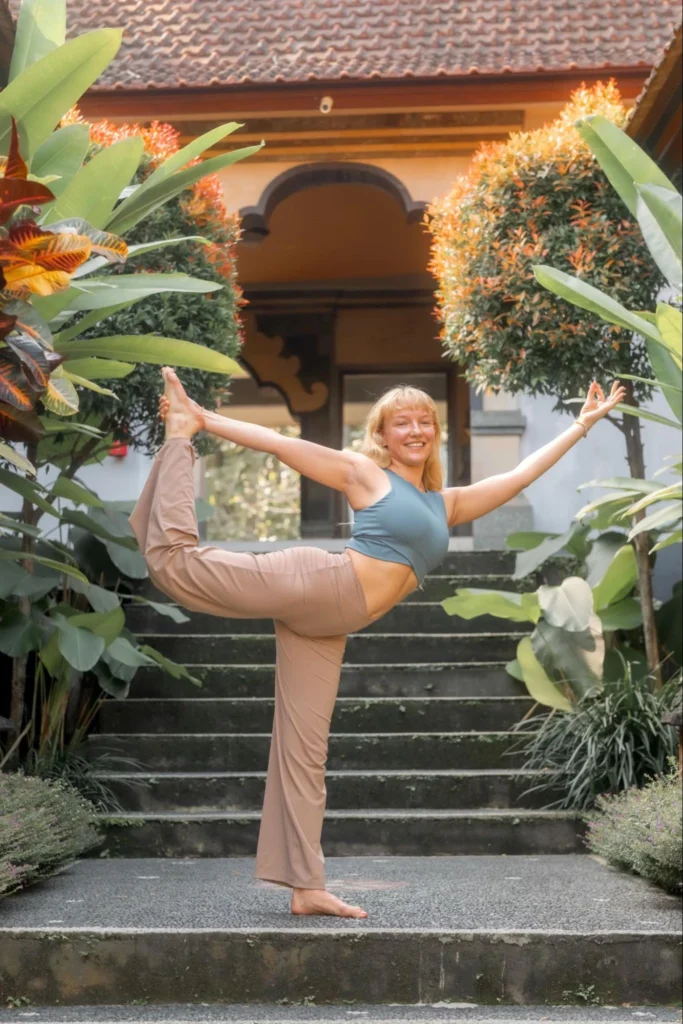
Hatha is a broad historical term covering much of what is now taught as physical yoga, and in contemporary studio usage it usually indicates a class built around individual postures rather than continuous flow.
In a teacher training, a Hatha emphasis typically means time spent breaking postures down: how a shape is organized, where the weight sits, what varies between bodies, and how to describe all of that out loud. For a trainee this is foundational work. Learning to see a posture clearly is what makes everything afterward teachable. Hatha is not automatically easy or beginner-only — held postures can be demanding, and pacing varies by program.
What Is Vinyasa Yoga in Teacher Training?
Vinyasa is defined less by a fixed set of postures than by the relationship between movement and breath, and by the transitions that connect one pose to the next.
In training, this is where sequencing becomes the subject. You learn how a class is constructed — what builds toward what, how to pace a room, how to cue a transition while people are already moving, and how to design a class that holds together rather than listing postures in order. This is the style that asks most of a teacher creatively, and the one where two classes under the same name can look entirely different. Not every Vinyasa class is fast; speed is a choice the teacher makes.
What Is Ashtanga Yoga in Teacher Training?
Ashtanga works with established sequences practiced in a consistent order, which changes how learning happens: progress comes from returning to the same material rather than from novelty.
Training within that structure means working with repetition, breath coordination, drishti and progression through a set sequence. For a teacher, the skill is different from Vinyasa — less about designing a class, more about guiding students through a fixed sequence and knowing when someone is ready to move on. Ashtanga is not fast yoga at all, speed is not a variable. Some Ashtanga classes can go fast, otherwise be slow, and a program that includes Ashtanga elements within a broader curriculum is not the same as a specialist Ashtanga training.
Which Style Is Better for Yoga Teacher Training?
None is universally better. The right emphasis depends on whether you value foundational posture study, creative sequencing, structured repetition, or exposure to several approaches before deciding.
Choose a Hatha Emphasis if…
You want detailed posture study, steadier pacing, and time on the mechanics of teaching a posture clearly. This may suit you if you expect to teach mixed-level or beginner groups.
Choose a Vinyasa Emphasis if…
You want to build and lead your own sequences, and you are drawn to breath-led transitions and class construction. This may suit you if creative freedom matters to how you want to teach.
Choose an Ashtanga Emphasis if…
You prefer structure, established sequence work and progression through repetition. This may suit you if you want a defined form to work within rather than one to design.
Single-Style vs Multi-Style Yoga Teacher Training
This is often the more consequential decision, and it is not the same question as which style you prefer.
| Factor | Single-style YTT | Multi-style YTT |
|---|---|---|
| Primary focus | One tradition in depth | Several approaches within one curriculum |
| Depth | Greater within that style | Less within any one style |
| Breadth | Narrower | Broader |
| Sequencing exposure | One approach to sequencing | Several, with the differences visible |
| Teaching perspectives | Consistent | Varied, which can be clarifying or confusing |
| Specialization | Established earlier | Deferred to later study |
| Potential fit | You already know what you want to teach | You do not yet, or you want the comparison |
One nuance worth stating plainly: a multi-style course gives broader exposure, but broader exposure is not the same as completing three specialist trainings. The section further down on specialization covers why.
Why Do Some 200-Hour YTTs Combine Multiple Styles?
Usually for a practical reason: at the foundation level, many students have not yet decided what they want to teach, and comparing approaches directly is difficult once you are inside a single tradition.
Combining styles can give trainees exposure to different sequencing approaches, establish shared postural foundations before layering flow or set sequences on top, and show the contrast between teacher-created and standardized class formats. Whether that serves you better than depth in one style depends on your goals — neither format is objectively superior, and plenty of excellent teachers come from each.
How Amertham Combines Hatha, Vinyasa and Ashtanga
Amertham is our residential 200-hour yoga teacher training location in Bali, running 20 nights — approximately three weeks — with students staying and training at the same property. Its curriculum is multi-style, and the three styles are sequenced rather than taught in parallel.
| Training stage | Main style focus |
|---|---|
| Week 1 | Hatha yoga foundation |
| Week 2 | Vinyasa Flow exploration |
| Week 3 | Ashtanga yoga and teaching development |
| End of training | Practical and theoretical assessments |
The ordering follows a legible progression. Week one establishes Hatha-focused foundational study — posture work and alignment before anything is strung together. Week two introduces Vinyasa sequencing and flow, which applies that foundation to continuous movement. Week three adds Ashtanga-oriented structured practice alongside teaching development, shifting the emphasis from practicing to instructing.
That is the structure we currently use for our Amertham training rather than a claim that this is the optimal teaching sequence for every student or program. What it does mean practically is that each style arrives with the previous one already in place, so the contrast between them is visible as you go.
| Explore Amertham’s Multi-Style 200-Hour YTT
If learning through Hatha foundations, Vinyasa Flow and Ashtanga within one residential program matches what you are looking for, review our current Amertham training details, dates and room options. View Amertham Program Details. |
What Else Is Included Beyond the Three Yoga Styles?
Asana style is one part of a 200-hour curriculum, and often not the part that decides whether you can teach.
Teaching Methodology and Alignment
Teaching methodology, alignment, hands-on adjustments, biomechanics and injury-prevention considerations — the group that turns practice into instruction.
Pranayama, Meditation and Yoga Nidra
Breathwork, meditation and guided relaxation, taught as techniques to deliver rather than only to practice.
Yoga Philosophy and Related Practices
The ideas the practice sits within, which give the physical material context.
Additional Practices
Our Amertham curriculum also includes shatkarma, Ayurveda, kirtan, sound healing and Voice Activation. For how a 200-hour program is typically put together overall, see what a 200-hour yoga teacher training covers.
Can Beginners Join a Multi-Style Yoga Teacher Training?
Yes, depending on the program’s entry requirements. Our Amertham training is open to all levels, including complete beginners, and you do not need to plan on becoming a yoga teacher to join. A multi-style curriculum is arguably easier to start from than a specialist one, since it does not assume you already know which tradition you want. For what a first training asks of you, see beginner yoga teacher training in Bali.
Does Multi-Style Training Mean You Become a Specialist in All Three?
No. A 200-hour multi-style curriculum provides structured exposure to several approaches; it does not provide specialist-level study in each tradition, and no 200-hour program could.
This matters because it is the most common misunderstanding about multi-style training. Two hundred hours across three styles plus philosophy, anatomy, methodology and practice teaching is a foundation, not three qualifications. What it does well is let you experience the differences firsthand and make a more informed decision about where to go deeper. Further specialization in any one tradition generally means additional focused study afterward, and what that requires depends on the style and your own goals.
How Do Hatha, Vinyasa and Ashtanga Affect Teaching Methodology?
The style you teach changes what you need to be good at, which is easy to miss when comparing them as practices rather than as teaching jobs.
With a Hatha emphasis, clear posture breakdown and alignment-focused instruction tend to carry the class — you have time to explain, and students expect you to use it. With Vinyasa, sequencing, transitions, pacing and cueing matter more, because you are talking while people are moving and the class holds together or does not based on how you built it. With Ashtanga, working inside a set sequence changes the job again: less designing, more observing, adjusting and judging readiness to progress.
Programs differ in how much attention they give each of these, which is worth asking about directly rather than assuming a style label covers it.
How Should You Compare Multi-Style YTT Curricula?
Twelve questions, because “multi-style” is a claim rather than a standard and schools apply it unevenly:
- Is each style actually taught, or only mentioned in the marketing?
- How is training time divided between them?
- Does the school explain the progression, or just list the styles?
- Is sequencing taught as a skill?
- Is teaching methodology a scheduled component?
- How much supervised practice teaching is included?
- How are alignment and modifications handled?
- What assessment is required, and when?
- Is the course foundational or specialist — and does the school say so plainly?
- What certificate is issued on completion?
- What are the teachers’ qualifications?
- Are current curriculum details published, or only available on request?
What Does the Amertham Residential Format Add?
Amertham is residential — 20 nights in a nature-based setting in Bali, with students staying and training on the same property. Our current Amertham packages include accommodation and meals. For a three-style curriculum this matters practically: the progression runs continuously rather than across weekly classes with gaps between them, so week two’s flow work follows directly on week one’s foundations. For more on evaluating this kind of setup, see our guide to nature-based yoga teacher training.
What Does Yoga Alliance Registration Mean for a Multi-Style YTT?

Studying three styles does not produce three credentials. YTT (Yoga Teacher Training) is the training program, RYS (Registered Yoga School) describes a school registered with Yoga Alliance at a given level, and RYT(Registered Yoga School) is an individual teacher registration subject to its own requirements.
Registration relates to the program and the school rather than to the styles taught within it, and program completion and individual registration are separate concepts. Before assuming what a certificate allows, understand Yoga Alliance 200-hour training and RYT registration.
Which Training Style Fits Your Goals?
| If you prefer… | Consider looking for more emphasis on… |
|---|---|
| Detailed posture study and alignment work | Hatha |
| Creative sequencing and class construction | Vinyasa |
| Structured repetition and set sequences | Ashtanga |
| Broad foundational exposure before specializing | A multi-style program |
| Depth in one tradition from the start | A single-style program |
Our Amertham training may suit students who want exposure to all three approaches within one 200-hour program. If that describes you, review our current Amertham curriculum, dates and room options. For the wider range of training options across the island, see our complete guide to yoga teacher training in Bali.
What Should You Check Before Booking a Multi-Style YTT?
Beyond the curriculum questions above, confirm the practical terms:
- The weekly structure and how many hours each approach receives
- Teacher qualifications for each style taught
- Anatomy and biomechanics coverage
- Assessment format and timing
- Accommodation and which meals are included
- The daily schedule
- Current dates and availability
- Cancellation and date-change policies
- The certificate issued, and the school’s current registration status
FAQs
What is the main difference between Hatha, Vinyasa and Ashtanga?
Hatha generally emphasizes individual postures and alignment, Vinyasa emphasizes breath-linked movement and teacher-designed sequencing, and Ashtanga uses established sequences practiced in a consistent order. These are tendencies rather than rules, and a specific teacher or program matters more than the label.
Is Hatha easier than Vinyasa or Ashtanga?
Not necessarily. Hatha often moves at a steadier pace, but held postures can be demanding and intensity varies widely by teacher and program. Difficulty depends far more on how a specific class or training is designed than on the style name.
Is Vinyasa yoga always fast?
No. Vinyasa is defined by movement linked to breath rather than by speed. Pace is a choice the teacher makes, and Vinyasa classes range from slow and deliberate to brisk depending on the intention behind the sequence.
Does Ashtanga always use the same sequence?
Ashtanga is built around established sequences practiced in a consistent order, which is central to how it works. Individual schools and teachers may vary in how strictly they apply this, so check how a specific program approaches it.
Can one yoga teacher training teach all three styles?
Yes. Multi-style 200-hour programs cover several approaches within one curriculum, usually by sequencing them rather than teaching them simultaneously. The trade-off is breadth over depth in any single tradition.
Does Amertham include Hatha, Vinyasa and Ashtanga?
Yes. Our Amertham 200-hour training works through a Hatha foundation in week one, Vinyasa Flow in week two, and Ashtanga alongside teaching development in week three, with practical and theoretical assessments at the end.
Can beginners join Amertham’s multi-style YTT?
Our Amertham training is open to all levels, including complete beginners, and you do not need to have teaching ambitions to join. Entry requirements differ between schools, so check each program individually rather than assuming.
Does a multi-style YTT give three separate certifications?
No. A multi-style 200-hour program issues one completion certificate for the program as a whole, not separate credentials per style. It provides structured exposure to each approach rather than specialist-level study in any of them.
Explore Amertham’s Multi-Style Yoga Teacher Training in Bali
There is no universally better style — only emphases that suit different learners and different teaching goals. The more useful question at the 200-hour level is whether you want depth in one tradition or exposure to several before deciding where to specialize. Our Amertham training takes the second approach, moving through Hatha, Vinyasa and Ashtanga in a defined three-week sequence. Whether that fits depends on your goals, and on current program details worth checking before you book.
| Explore Amertham’s Multi-Style Yoga Teacher Training in Bali
Review our current curriculum details, training dates and room options on the Amertham program page. Explore Amertham 200-Hour YTT. |