
Choosing where to train matters almost as much as choosing what to train in. A 200-hour course asks for roughly three uninterrupted weeks of your attention, and the setting either supports that or competes with it.
This article looks at Koh Phangan specifically: what the island actually offers a trainee, what the practical trade-offs are, and how to judge whether it suits how you learn. It is written for someone deciding between destinations rather than someone already booked.
Is Koh Phangan Good for Yoga Teacher Training?
| Short answer
Koh Phangan suits an intensive yoga teacher training if you want a small, low-distraction environment where the training is the main thing happening. A large share of the island is protected national park, and it has a long-standing yoga and wellness presence. The trade-off is access: there is no airport, so every arrival involves a ferry, and the island has fewer services than a mainland city. |
That trade-off is the whole decision in one sentence. The rest of this article unpacks both sides of it.
Why Is Koh Phangan a Popular Destination for Yoga Teacher Training?
A protected natural environment
A significant part of the island falls inside Than Sadet–Ko Pha-ngan National Park, which covers forest, waterfalls, and stretches of coastline. The practical effect for a trainee is that development is constrained. Large parts of the island stay undeveloped, and the areas around them stay quiet.
That matters more during a training than during a holiday. Three weeks of early starts leaves you needing genuine downtime, and downtime is easier to find where there is less going on.
An established profile as a destination
Koh Phangan is well known internationally, though often for the wrong reasons if you are researching a training. Condé Nast Traveler readers voted it the third best island in Asia in the magazine’s 2020 Readers’ Choice Awards. That ranking is now several years old and reflects general travel appeal rather than anything about yoga education, so treat it as context rather than evidence.
The island’s better-known nightlife is concentrated at Haad Rin on the southeast tip. Most yoga schools are elsewhere, and the two rarely overlap in daily life. Worth knowing if the Full Moon Party reputation is putting you off.
What Makes Koh Phangan Different From Other Training Destinations?

Two practical differences separate an island training from a mainland or city one, and both are worth planning around.
Getting there takes a full day
Koh Phangan has no airport. Every arrival involves a ferry, and most arrive at Thong Sala, the island’s main pier and largest town. The usual routes:
- Fly to Koh Samui (USM), then a short ferry crossing — the quickest route, and the most expensive flights
- Fly to Surat Thani (URT) on the mainland, then a bus-and-ferry transfer — cheaper, and a longer day
- Fly to Nakhon Si Thammarat (NST), then transfer — usually the cheapest and the longest
Standard ferry services generally run during daylight hours. Book a flight that lands late on the day your course starts, and you risk missing the last crossing, which means an unplanned night on Samui and a first morning you did not budget for. Arrive a day early if the schedule allows.
The rainy season runs on a different calendar
This is the single most useful thing to know before choosing a date. Koh Phangan sits in the Gulf of Thailand, not on the Andaman coast, and its weather does not follow Phuket’s. Thailand’s National Climate Center notes that the northeast monsoon, which begins in mid-October, brings abundant rain along the eastern coast of the southern region.
So the months many travellers assume are dry season are, on this coast, the wettest. Training runs regardless, and the island is greener and quieter then. But pack accordingly, and expect ferry schedules to be more weather-dependent at that time of year.
| Practical factor | Island setting (Koh Phangan) | Mainland or city setting |
|---|---|---|
| Arrival | Flight plus ferry; allow most of a day | Usually a direct transfer from an airport |
| Daily distractions | Fewer; the training tends to be the main event | More competing options nearby |
| Local transport | Scooter or taxi for most trips | Usually walkable or well served by transport |
| Services and amenities | Concentrated in a few towns | Widely available |
| Weather planning | Gulf calendar; wettest from around October | Varies by region |
Train by the Beach: House of Om’s Koh Phangan Location
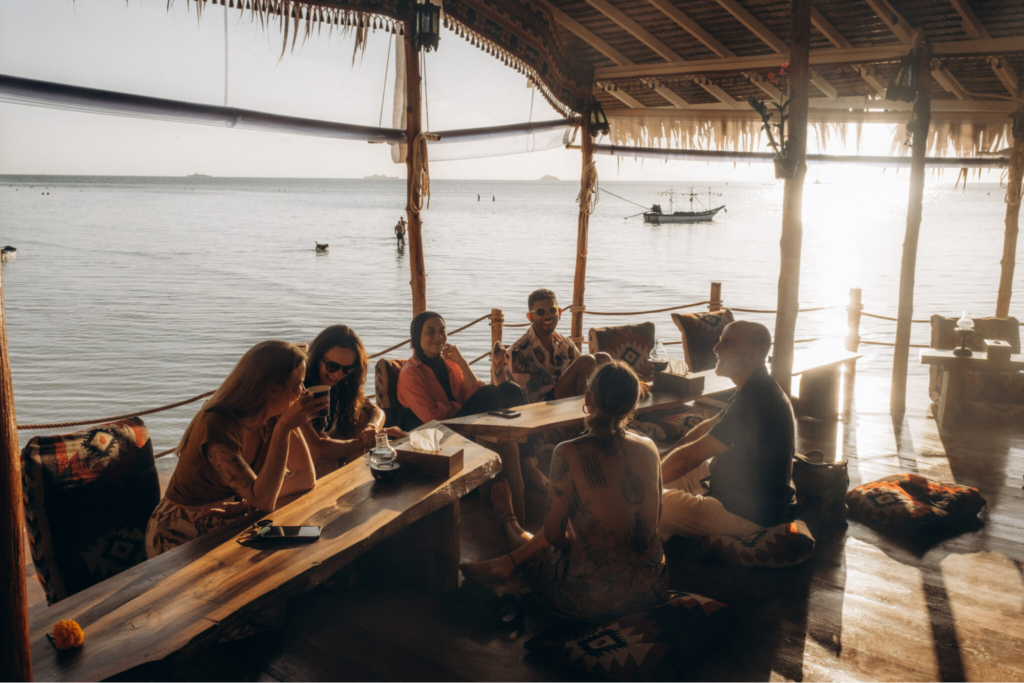
House of Om describes its Koh Phangan campus as a beachfront resort sitting directly on the shore, with direct access to the sand. The school’s own locations page places the Koh Phangan site at Bovy Beach, on the island’s western side. It is the newest of the school’s campuses, alongside its four sites in Bali and its ashram in Rishikesh.
Beachfront is a genuine practical difference rather than a photograph. It means the walk between your room and the shala is short, and it means the sea is available in the gaps between sessions without arranging transport. On a schedule that starts at six in the morning, both of those things reduce friction.
What Is Bovy Beach Like?
Bovy Beach sits on the western coast of Koh Phangan. In practical terms, that means sunsets rather than sunrises over the water, and a position away from the busier southeast of the island.
House of Om describes the setting as tropical and laid-back, with palm trees, sea breeze, and the beach right outside. The resort sits directly on the beach, so students can step straight onto the sand without needing to travel anywhere.
| Verification note
Bovy Beach is named on House of Om’s location map and on the Hybrid Thailand program page. The 200-hour program page describes the location as a beachfront resort without naming the beach. Confirm that both Thailand programs run from the same site before publication. |
What Is the Training Environment Like in Koh Phangan?
The environment shapes the rhythm of a training more than most people expect. House of Om’s Thailand course runs early: practice begins at six in the morning and the day ends with evening sadhana. Full details of the structure are covered on the 200-Hour Yoga Teacher Training in Koh Phangan page.
An early schedule works better in a setting that goes quiet at night. It also means the hottest part of the afternoon falls between sessions rather than during practice — a small thing that matters in a tropical climate.
If you are weighing settings more broadly, our guide to how different natural environments shape a training compares coastal, mountain, and ashram options.
Is Koh Phangan Suitable for an Intensive Yoga Teacher Training?
For most people, yes — but the setting suits some temperaments better than others, and it is worth being honest with yourself about which you are.
An island setting tends to suit you if
- You concentrate better when there is less available to do
- You want the sea as your recovery, rather than a city to explore
- You are content with a small number of restaurants, shops, and cafes for three weeks
- You would rather commit fully than keep one foot in normal life
You may prefer elsewhere if
- You need reliable, fast travel in and out for work or family reasons
- You have a medical condition that needs ready access to specialist care
- You get restless without variety and a change of scene
- You want to combine the training with substantial city travel on the same trip
None of these is a small consideration dressed up as a big one. Three weeks is long enough for a poor environmental fit to affect how much you get from the course.
What Accommodation and Daily Living Considerations Matter?
House of Om’s Thailand program includes 19 nights’ accommodation at the beachfront resort, with several room options ranging from shared to private. The training itself is the same whichever you choose.
The choice worth thinking about is not cost but recovery. Shared rooms build the cohort quickly, which many people value. Private rooms give you somewhere to decompress when the middle of the course gets demanding. If you know you need solitude to process, factor that in early rather than after arrival.
Day-to-day practicalities on an island:
- Cash and errands: Thong Sala is the main town for banks, pharmacies, and general shopping
- Getting around: most trips outside the resort need a scooter or taxi
- Laundry: worth confirming with the school rather than packing three weeks of clothes
- Connectivity: fine for staying in touch, but plan around it rather than assuming you can work
- Meals: House of Om provides fresh vegetarian, Ayurvedic-inspired meals prepared with organic ingredients. Raise any allergies or dietary requirements at the enquiry stage
What Should You Consider Before Booking a Yoga Teacher Training in Koh Phangan?
Six questions worth settling before you pay a deposit:
- Which month are you booking, and does it fall in the Gulf’s wetter period from around October onward?
- Have you allowed a buffer day for the ferry connection, in both directions?
- Does your travel insurance cover course fees, not just medical costs?
- What is the group size for your specific intake?
- What happens if illness causes you to miss sessions, and how are hours made up?
- Are you booking the full residential course, or would a shorter in-person format fit your circumstances better?
On that last point: House of Om runs a separate 200-Hour Hybrid Yoga Teacher Training on Koh Phangan, with a shorter in-person component and theory completed online. It is a different format rather than a lesser one, and it exists for people who cannot take a full month away.
Why Choose House of Om for Yoga Teacher Training in Koh Phangan?
If Koh Phangan fits how you want to train, these are the things worth checking against any school you shortlist, House of Om included:
- Location: a beachfront campus with direct access to the sand, so the setting is part of the daily routine rather than a weekend excursion.
- Format: a residential 200-hour course with 19 nights’ accommodation and a choice of room types, plus a hybrid alternative if the full residential format does not fit.
- Entry: House of Om states that all levels are welcome, including complete beginners, and that students do not need teaching ambitions to join. However, at least 6 months of consistent practice will make the course easier.
- Teaching team: named in advance on the school’s teachers page, so you can see who is leading a course before booking.
- Verifiable rating: House of Om holds a 4.66 out of 5 rating on the Yoga Alliance directory, which you can check independently rather than take on trust.
You can compare every House of Om program across Thailand, Bali, India, and online if you are still weighing destinations.
Frequently Asked Questions
Is Koh Phangan good for yoga teacher training?
It suits trainees who want a low-distraction setting where the course is the main focus. Much of the island is a protected national park, and there is a long-established yoga and wellness presence. The main trade-off is access, since every arrival involves a ferry.
Why is Koh Phangan popular for yoga?
A combination of protected natural surroundings, a settled wellness scene, and an island scale that makes it easy to keep a routine. The busier nightlife is concentrated in one area, so it rarely intersects with a training.
Where is yoga teacher training held in Koh Phangan?
Schools are spread around the island rather than in one district. House of Om’s Koh Phangan campus is a beachfront resort, listed on the school’s location map at Bovy Beach on the western coast.
What is Bovy Beach like?
It sits on the western side of Koh Phangan, which means sunsets over the water and a position away from the busier southeast. House of Om describes its campus there as beachfront with direct access to the sand.
Is accommodation included in yoga teacher training in Koh Phangan?
It depends on the school. House of Om’s Thailand program includes 19 nights’ accommodation at its beachfront resort, with a choice of shared and private rooms. Always confirm what a quoted price covers before comparing schools.
Is Koh Phangan suitable for beginners?
The location makes no difference to whether a course suits beginners; the school’s entry policy does. House of Om states that all levels are welcome, including complete beginners, and that students do not need teaching ambitions to enrol.
What should I consider before choosing a training date?
Weather is the main variable specific to this island. The Gulf coast is wettest from around October, which is the reverse of Thailand’s Andaman side. Also check flight availability and allow a buffer day for the ferry connection.
How do I get to Koh Phangan for yoga teacher training?
There is no airport on the island. Most people fly to Koh Samui, Surat Thani, or Nakhon Si Thammarat and continue by ferry, usually arriving at Thong Sala pier. Allow most of a day for the final leg, and avoid booking a late arrival on the day your course starts.
Deciding Whether Koh Phangan Fits
The island rewards people who want to disappear into a course for three weeks and treat the sea as the recovery. It asks for a longer journey in, a bit more planning around weather, and a willingness to live simply for the duration.
If that sounds like the right trade, look at the Koh Phangan training dates and accommodation options and work backwards from a month that suits you.