
Choosing a yoga teacher training during Black Friday isn’t just about finding the lowest price. It’s about finding a program that fits your life, learning goals, and schedule.
Residential training offers an immersive experience, hybrid training combines independent online study with in-person practice, and online training lets you learn remotely. Each format comes with different commitments, travel requirements, and costs.
This Black Friday, we’re calling our campaign The Reset. From November 16–30, 2026, we’re bringing special offers to eligible House of Om training programs, including residential, hybrid, and online options. Our India programs are excluded.
Before you book, compare what each format offers and decide which experience suits you best.
Residential vs Hybrid vs Online YTT at a Glance

| Factor | Residential | Hybrid | Online |
|---|---|---|---|
| Primary learning setting | The training location | Split between home and the training location | Wherever you study |
| Travel required | Yes, for the full course | Yes, for the in-person component only | None |
| In-person component | The entire program | A defined block, shorter than a full residential course | None |
| Schedule structure | Fixed daily timetable set by the program | Flexible online, fixed during the in-person block | Varies — may mix self-paced study with scheduled sessions |
| Independent study | Limited — days are structured for you | Substantial, in the online portion | Substantial — you manage most of the pace |
| Accommodation needed | For the full course; often part of the package | During the in-person block only | None |
| Community experience | Living and training alongside the same group throughout | Online first, then in person with the group | Through scheduled sessions and groups where the program includes them |
| Best suited for | Those who can take continuous time away and want full immersion | Those who want in-person training with less time away | Those who cannot travel or need to study around commitments |
What Is Residential Yoga Teacher Training?
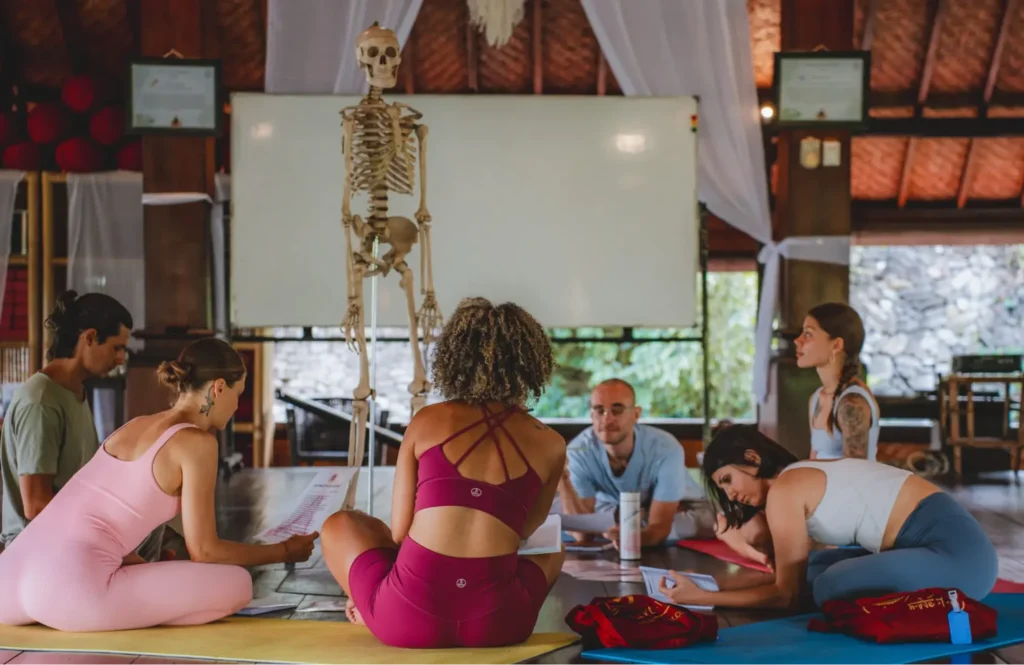
A residential yoga teacher training brings students to the training location for an in-person course, with daily sessions and accommodation organized around the program.
The appeal is immersion. You step out of normal life for the length of the course, follow a schedule someone else has built, learn face to face, and spend the whole period with the same group. Everyday distractions largely disappear, and practical sessions happen in the room with you.
The trade-offs are real too. You travel, the dates are fixed, and you need a continuous block away from work or family. Accommodation and travel costs form part of the overall budget, and the days are usually fuller than people expect. Inclusions differ between programs, so check what any given residential course covers rather than assuming meals and a room are part of the price.
Our Residential Training at Amertham

Our 200-hour training at Amertham is a residential course in Bona, Gianyar, Bali — a secluded jungle location above a deep river gorge, with dense greenery and flowing water around the training space. It runs as a 20-night program and is open to all levels, including complete beginners.
The course moves through a Hatha foundation in week one, Vinyasa Flow in week two, and Ashtanga elements with teaching development in week three, finishing with practical and theoretical exams. Accommodation is included, along with breakfast, lunch and dinner. Our airport transfers are not included in the program, but you’ll have access to our list of trusted drivers who have been driving our students for years, so you can easily arrange a reliable transfer to and from the training location.
We run residential training at other locations too — our program at The Mansion in Ubud and our training in Koh Phangan in Thailand — each with its own setting, schedule and inclusions. These do not carry across, so read the page for the one you are considering.
What Is Hybrid Yoga Teacher Training?
Hybrid training combines online learning with an in-person component. You complete part of the course remotely, usually the theory, and then join a scheduled block at the training location for the practical work.
The point of the format is often misunderstood. Completing theory online makes the in-person block shorter than a full residential course, not longer. That suits people who want genuine in-person training but cannot take three continuous weeks away.
What it asks in return is self-direction. The online portion only works if you actually do it, and you are managing two sets of requirements rather than one. You still travel, and the structure varies considerably between schools, so look at how any particular program splits the two halves.
Our Hybrid Training

Our 200-hour hybrid training at Melati, in Bali near Ubud, pairs a self-paced online library with a 10-day in-person immersion covering 9 nights. The online portion holds video lessons, study modules and quizzes, has no scheduled sessions, and stays available to you after the course. The in-person days run a full timetable. It is open to all levels, and accommodation is included across several room categories, with two meals a day on training days.
We run two other hybrid programs. Our Signature Hybrid in Koh Phangan follows a similar split at our beachfront site in Thailand. Our 300-hour hybrid at Pelaga runs in the quiet Bali highlands, a nature-based setting suited to deeper meditation practice, and is designed for people who have already completed a 200-hour training rather than for beginners.
What Is Online Yoga Teacher Training?

Online training lets you complete the course remotely rather than traveling to a training site. It removes the travel question entirely, which for many people is the deciding factor.
The format varies more than any other, and the word “online” tells you very little on its own. Some programs are entirely self-paced recordings. Others run on a set timeline with live sessions, deadlines, assignments and feedback. Both are called online training, and they are quite different experiences.
So the question to ask is not whether a program is online but how it is delivered: are there live sessions, are there deadlines, who gives you feedback, how are you assessed, and how long do you have access. The answers decide whether it will actually fit around your week.
Our Online Training

Our 200-hour online training is not purely self-paced. It combines self-paced modules with a study group, expert-led workshops and group mentoring calls on a set timeline, and students are matched to a group and a personal mentor by timezone. It includes 30+ hours of live online training, and assessments include a recorded teaching demonstration rather than written work alone. The platform stays available to you after you finish.
That structure is worth knowing before you choose, because a program with scheduled live sessions asks something different of your calendar than one made only of recordings. Neither is better in the abstract; they suit different weeks.
Does Your Training Format Affect Yoga Alliance Registration?
Not in itself. Yoga Alliance’s standards for Registered Yoga Schools state that a school can offer training in multiple formats, including fully in person, fully through distance learning, or a mix of both. There is no maximum online percentage and no in-person requirement.
There is one requirement worth understanding, because it affects which online programs are worth your time. Schools must deliver a minimum of 15% of program hours synchronously — meaning teachers and students online at the same time, interacting in real time. For a 200-hour program that is 30 hours. A course made entirely of recorded material with no live component would not meet that standard.
This is a useful filter when you are comparing online programs. If a program cannot tell you how many live hours it runs, that is worth asking about directly.
Two terms are worth keeping straight while you compare. A Registered Yoga School, or RYS, is a school registered with Yoga Alliance. Registered Yoga Teacher, or RYT, is a designation you apply for yourself after completing a qualifying training. Finishing a course gives you that school’s completion certificate; registering as an RYT is a separate step you take afterward.
Which Format Is Best for Beginners?
No format is universally best for beginners. What matters more is whether the specific program welcomes them and how much guidance it builds in.
If you are new to this, check that the program explicitly says beginners are welcome, then look at how much direct access to teachers you get, how the curriculum is structured, what the physical practice expectations are, how feedback reaches you, and how you are assessed. A beginner generally benefits from more guidance rather than more flexibility, and the formats differ in how guidance arrives rather than in how much of it there is.
Our Amertham training is open to all levels, including complete beginners, as is our hybrid training at Melati. Our 300-hour hybrid at Pelaga is not a starting point — it is built for people who already hold a 200-hour certificate. Beginner-friendly also does not mean undemanding: a 200-hour course involves early starts, daily practice, theory, teaching methodology and assessments, and asks you to take part throughout. If you are weighing this up, our guide for beginners covers the groundwork in more detail.
Can You Do Yoga Teacher Training While Working Full Time?

Often, yes, but the answer depends on your specific schedule rather than on the format label.
Online and hybrid formats can offer more scheduling room, since neither requires a continuous block away for the whole course. That flexibility is not automatic, though. Before assuming a program fits around a job, check whether it has live sessions and when they run, whether there are submission deadlines, roughly how many study hours a week it expects, which in-person dates you would need to travel for, and how assessments are scheduled. A program with weekly live calls at an awkward hour for your timezone may be harder to fit around work than a residential course you take as annual leave.
Residential training is not off the table for employed students either. It concentrates the whole commitment into one block, which some people find easier to arrange than months of evenings.
Which Format Gives the Most Immersion?
Residential training generally provides the most continuous physical immersion, because you are at the training location for the whole course and living alongside the same group throughout.
Worth separating, though: more immersion is not the same as better teaching, better curriculum or a better outcome as a teacher. Those depend on the program itself. Immersion is a description of the experience, not a measure of educational quality, and students complete excellent trainings in all three formats.
How Teaching Practice Differs by Format
Learning to teach and learning to practice are different skills, and how a program handles the first is worth checking in any format.
Ask how teaching methodology is actually taught rather than described, whether supervised practice teaching is included and how much, who gives you feedback and in what form, and how practical assessment works. Formats handle this differently — an in-person practicum and a recorded teaching demonstration are both legitimate approaches with different strengths — but what matters is that the program has a clear answer. A course that is vague about teaching practice is telling you something regardless of how it is delivered.
What Each Format Costs You Beyond Tuition

Comparing course fees alone will mislead you, because the formats carry different surrounding costs.
A residential course usually involves the program fee, accommodation and meals where included, international flights, airport transfer and local travel, plus personal spending for the period. A hybrid course has the program fee and the online component, with accommodation, flights and transfers attached only to the shorter in-person block. An online course avoids flights and destination accommodation, though you still need a reliable setup to study with, and the course fee itself is the figure to check rather than assumed.
Build the full cost of attending for each option you are considering, then compare those totals. That is the only comparison that means anything.
Which Format Fits You?
Choose residential if…
You want continuous in-person immersion. You can commit to fixed dates and take the full period away. You value living and practicing in the training environment rather than fitting study around normal life. Travel is practical for you, and you would rather concentrate the whole commitment into one block.
Choose hybrid if…
You want genuine in-person training but cannot spend the full course period away. You are comfortable working through theory independently beforehand. You can commit to the in-person dates, and a shorter trip fits your work or family situation better than a longer one.
Choose online if…
Travel is difficult or impractical for you. Remote learning suits how you work, and you are comfortable organizing study from home. You have checked the program’s live sessions and deadlines against your own schedule and they fit. You would rather study over a longer period than step away from everything at once.
Residential vs Hybrid vs Online YTT: Which Is Best?
There is no single best format for everyone. Each is best suited to a particular set of circumstances, and the useful question is which of these sounds most like yours.
| If your priority is… | The format best suited to it |
|---|---|
| Deep, continuous in-person immersion | Residential |
| In-person training with less time away from work | Hybrid |
| Studying when international travel is difficult | Online |
| A fixed physical environment with the schedule handled for you | Residential |
| Flexibility over where you are based during the course | Online |
| Learning theory at your own pace before practical work | Hybrid |
| Maximum face-to-face time with teachers and classmates | Residential |
| Spreading the commitment across a longer period | Online or hybrid |
If two of these describe you, the tiebreaker is usually travel: how much continuous time you can realistically take away decides more than preference does.
| Compare Our Training Formats
See our residential, hybrid and online programs side by side, with current dates, locations and what each one includes. Explore our programs. |
FAQs
Which yoga teacher training format should I choose?
Choose residential for a structured in-person immersion, hybrid to combine online study with a shorter in-person block, and online if travel is difficult. The right choice depends on how much continuous time you can take away, how easily you can travel, and how much in-person experience you want.
What is the difference between residential and hybrid YTT?
Residential training takes place entirely at the training location across one continuous period. Hybrid training moves part of the course, usually the theory, online, so the in-person block is shorter. Both involve travel; hybrid requires less continuous time away.
What is the difference between hybrid and online YTT?
Hybrid training includes a required in-person component at a training location. Online training does not involve travel at all. Both include remote study, but only hybrid brings you to a physical site for part of the program.
Is residential yoga teacher training better for beginners?
Not automatically. What matters is whether the program welcomes beginners and how much guidance it provides. Beginners generally benefit from more direct access to teachers and clear structure, which different formats deliver in different ways. Check the specific program rather than the format.
Can I complete yoga teacher training while working full time?
Often, yes. Online and hybrid formats can offer more scheduling room, but check live-session times, deadlines, expected study hours and any in-person travel dates against your actual work schedule before assuming a program fits.
Does online yoga teacher training include live classes?
It depends on the program. Some are entirely self-paced recordings; others run live sessions on a set timeline. Our online 200-hour training includes 30+ hours of live training alongside self-paced modules, with a study group and a mentor matched by timezone.
Does hybrid yoga teacher training require travel?
Yes. The in-person component takes place at a training location, so travel is required for that block. The block is shorter than a full residential course because part of the course is completed online beforehand.
Is accommodation included in residential yoga teacher training?
It varies by program, so check rather than assume. Accommodation is included in our Amertham training along with breakfast, lunch and dinner. Other programs include different arrangements, and what is covered is set out on each program page.
Does the training format affect Yoga Alliance registration?
Not in itself. Yoga Alliance standards allow schools to deliver training fully in person, fully through distance learning, or a mix, with no in-person requirement. Schools must deliver at least 15% of program hours synchronously, which is 30 hours for a 200-hour program.
Which House of Om format should I choose?
That depends on your circumstances rather than on which program we would recommend generally. If you can take continuous time away, our residential trainings suit that. If you want in-person work with a shorter trip, our hybrid programs do. If travel is difficult, our online training does. Contact our team if you would like help working it out.
Choosing Your Format
Start with the constraint rather than the preference. How much continuous time you can take away, and how easily you can travel, will narrow three options to one or two faster than any other question. Once you know which formats are realistic, compare the actual programs within them — curriculum, teaching practice, teachers, inclusions and schedule — because that is where the real differences between courses live.
If you are comparing our programs during a seasonal promotion, choose the format first and review the offer second. A discount changes what a course costs; it does not change whether the format fits your life. Explore our programs to see our residential, hybrid and online options together.
Find Your Training. Begin Your Reset.
Whether you want to train in Bali, join us in Thailand, or study from home, start with a program that supports your goals.
The Reset runs from November 16–30, 2026. Explore our eligible programs, review the offer, and decide which path is right for you.