
Choosing a yoga teacher training involves more than comparing locations, dates, and prices. The style emphasis of a program shapes how you practice, how you learn to sequence a class, how physically demanding the days feel, and which students you will be best prepared to teach.
Three approaches appear most often in 200-hour and 300-hour trainings: Hatha, Vinyasa, and Ashtanga. They share roots, and the boundaries between them are less rigid than marketing sometimes suggests, but they differ meaningfully in pace, structure, and method.
| There is no universally best style. Hatha may suit students who value foundations, alignment, and detailed instruction. Vinyasa may suit those who enjoy breath-led movement and creative sequencing. Ashtanga may suit those who prefer structure, repetition, and progression within an established method. A multi-style 200-hour training can be a useful option if you are still deciding. |
One point worth establishing early: many 200-hour programs are multi-style rather than dedicated to a single tradition. House of Om is one example — its current Thailand 200-hour program describes itself as rooted in Hatha and Vinyasa Flow, with elements of Ashtanga.
Hatha vs. Vinyasa vs. Ashtanga: At a Glance
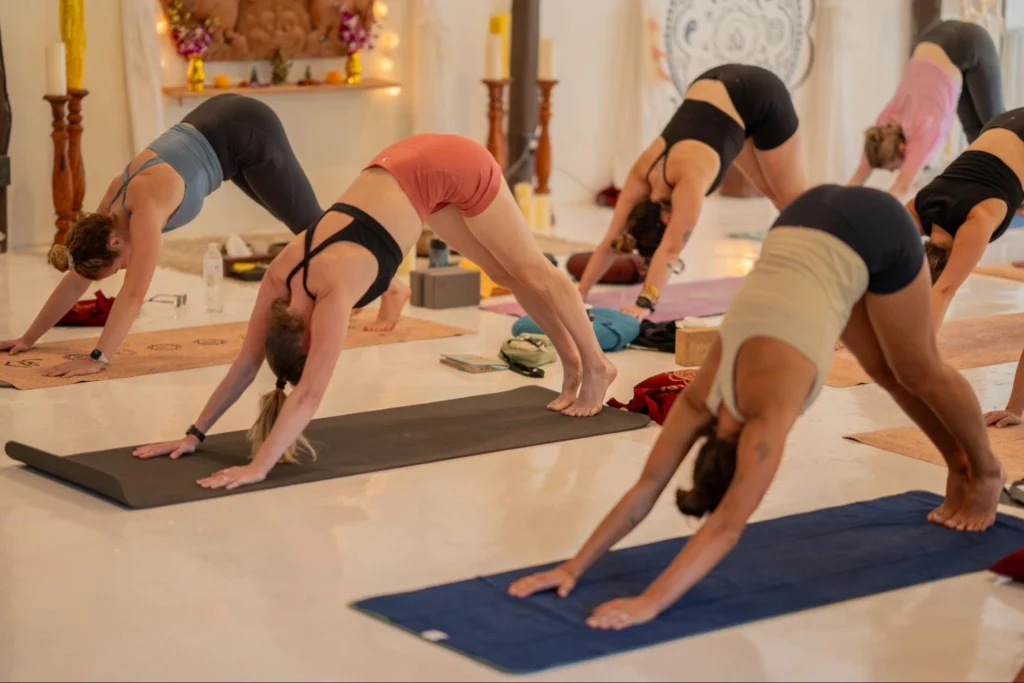
| Feature | Hatha | Vinyasa | Ashtanga |
|---|---|---|---|
| Typical pace | Often slow to moderate | Moderate, continuous | Steady and breath-linked |
| Structure | Usually teacher-designed | Usually teacher-designed | Established sequences |
| Sequencing | Flexible, varies by class | Creative, varies by class | Progressive within a set series |
| Breath relationship | Breath awareness within holds | Movement linked to breath | Specific breathing method throughout |
| Main emphasis | Alignment, steadiness, breath | Flow, transitions, class design | Discipline, repetition, progression |
| Teaching approach | Detailed verbal instruction | Creative class construction | Consistent method and progression |
| Physical demand | Often slower, but varies | Ranges from gentle to vigorous | Typically demanding |
| Variety between classes | Moderate | High | Low by design |
| May suit | Students who value precision | Students who enjoy variety | Students who value structure |
| Learning style | Methodical and detailed | Adaptive and creative | Repetitive and cumulative |
These are tendencies rather than rules. Intensity, pacing, and structure vary considerably between individual teachers and schools, so a Hatha class with one teacher may be more demanding than a Vinyasa class with another.
What Is Hatha Yoga?
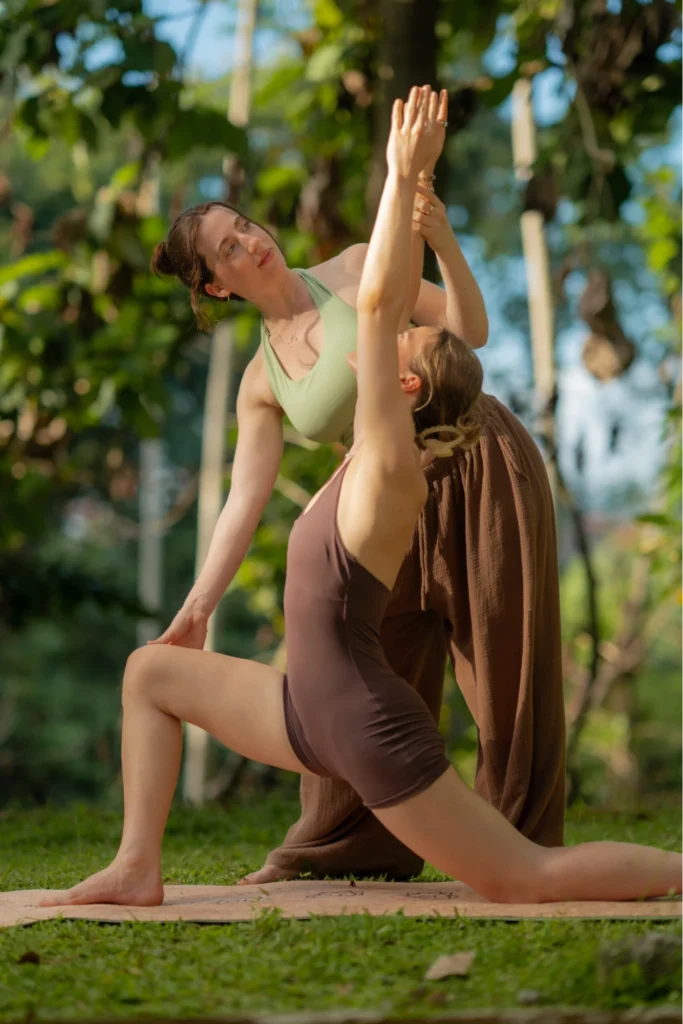
The word carries two meanings, and confusing them causes most of the misunderstanding around this style.
Traditionally, Hatha Yoga refers broadly to the physical practices of yoga as a whole — asana, pranayama, mudra, cleansing practices, and meditation. In that sense, Vinyasa and Ashtanga both sit within the Hatha tradition.
In modern studios, a class labeled Hatha usually means something narrower: a slower practice built around individual postures, with pauses between them and detailed attention to alignment.
What Hatha-focused training emphasizes
- How to enter and exit postures safely
- Alignment principles and how to modify for different bodies
- Holding postures with attention rather than moving through them
- Breath awareness within sustained shapes
- Clear verbal instruction, since there is time to explain
- Pranayama and meditation as practices in their own right
Slower does not mean easier. Holding a posture with proper alignment while maintaining steady breathing is demanding in a different way than moving quickly, and many students find sustained holds harder than transitions.
Hatha may suit you if you like studying detail, prefer a methodical learning environment, or want to teach beginners, private clients, or mixed-level groups where clear instruction matters more than pace.
What Is Vinyasa Yoga?
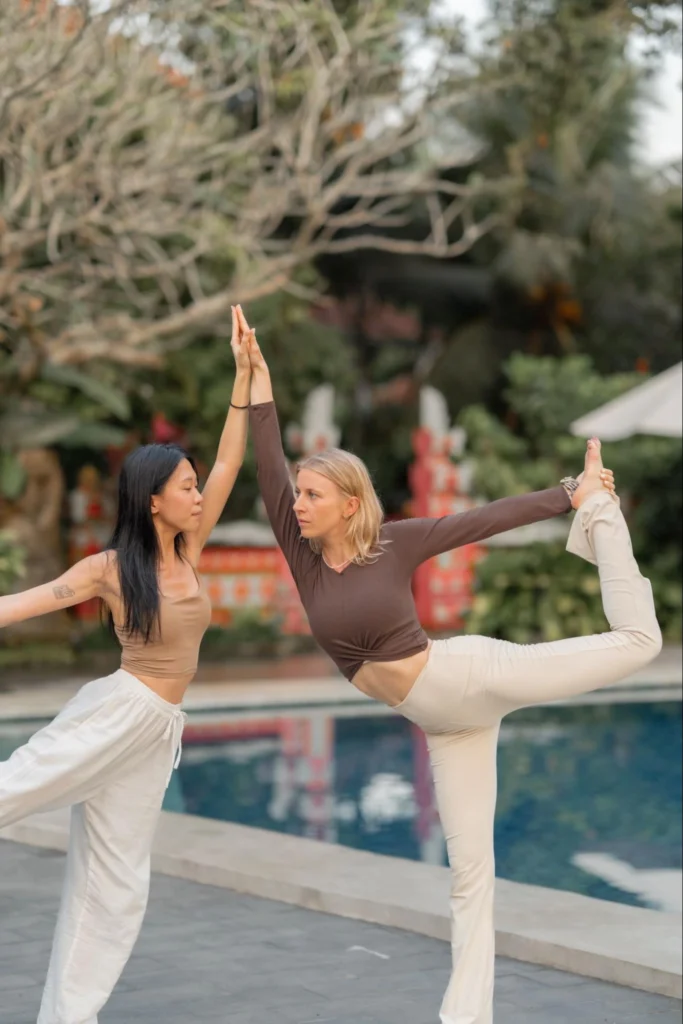
Vinyasa refers to linking movement with breath in a continuous sequence. Rather than holding postures separately, each movement is coordinated with an inhale or exhale, creating a flowing practice.
The defining feature for a teacher is that sequences are generally designed rather than inherited. A Vinyasa teacher builds a class with a beginning, a build, a peak, and a close — which means sequencing is a skill you have to learn rather than a series you memorize.
What Vinyasa-focused training emphasizes
- Breath-synchronized movement and transitions
- Sequencing principles and intelligent progression
- Class planning around a theme or peak posture
- Pacing, and reading the energy of a room
- Modifications so a flowing class stays accessible to mixed levels
That creative freedom carries responsibility. A sequence that looks impressive is not automatically safe or appropriate for the people in the room. Strong Vinyasa training therefore spends real time on anatomy and sequencing logic, not only on transitions.
Vinyasa may suit you if you enjoy continuous movement, want to design original classes, and expect to teach group sessions where variety keeps students returning.
What Is Ashtanga Yoga?

Ashtanga is a structured system built around established sequences. Students work through a defined series, practicing largely the same postures in the same order over time, which allows progress to be observed against a constant.
Characteristic elements include a specific breathing technique used throughout, drishti or focused gaze, bandhas and internal awareness, and gradual progression through the series as a practitioner becomes ready for additional postures.
Traditional Ashtanga is also associated with Mysore-style practice, in which students move through the sequence at their own pace within a shared room while the teacher gives individual adjustments. That is a feature of the tradition rather than something every program that references Ashtanga necessarily includes.
| A common misunderstanding
Ashtanga is not simply “fast yoga,” and a vigorous flowing class is not automatically Ashtanga. The defining features are the established sequence and the method — the breathing technique, the gaze points, the bandhas, and the progressive structure — rather than speed or intensity alone. |
Ashtanga may suit you if you value routine and measurable progression, are drawn to studying within a defined lineage, or want the discipline that comes from repeating a practice rather than varying it.
It may suit you less if you want every class to feel different, or if you are looking for a gentle training environment. Anyone considering an Ashtanga-focused program should ask specifically how it handles injuries, modifications, rest days, and different body types.
Hatha vs. Vinyasa vs. Ashtanga: Which Is Right for You?

Choose a Hatha emphasis if
- You enjoy studying alignment and posture in detail
- You want a strong foundation before specializing
- You prefer clear structure with pauses to absorb instruction
- You expect to teach beginners, private clients, or mixed-level groups
- You are interested in breathwork and meditation as distinct practices
Choose a Vinyasa emphasis if
- You enjoy continuous, breath-led movement
- You want to design your own classes rather than teach a set series
- You like variety in both your practice and your teaching
- You expect to teach group classes in studios, retreats, or online
Choose an Ashtanga emphasis if
- You value structure, repetition, and consistency
- You want to progress within a defined system
- You are interested in breath technique, gaze, and bandhas
- You are drawn to studying a specific lineage and its methodology
Choose a multi-style training if
- You are new to teacher training and still exploring
- You want exposure to several approaches before committing to one
- You expect to teach varied students in varied settings
- You want both foundational precision and sequencing skill
| If your goal is | You may prefer | Why |
|---|---|---|
| Building strong foundations | Hatha emphasis or multi-style | More time on individual postures and alignment |
| Learning creative sequencing | Vinyasa emphasis | Sequencing is the core skill rather than a fixed series |
| Following a structured method | Ashtanga emphasis | Established sequences and progressive practice |
| Exploring several approaches | Multi-style | Exposure before specializing |
| Teaching varied students | Multi-style | A broader toolkit for mixed settings |
| Deepening one established method | Single-style or advanced training | Depth within a defined lineage |
| Studying advanced sequencing | 300-hour training | Builds on an existing foundation |
Which Style Is Best for Yoga Teacher Training Beginners?
| Direct answer
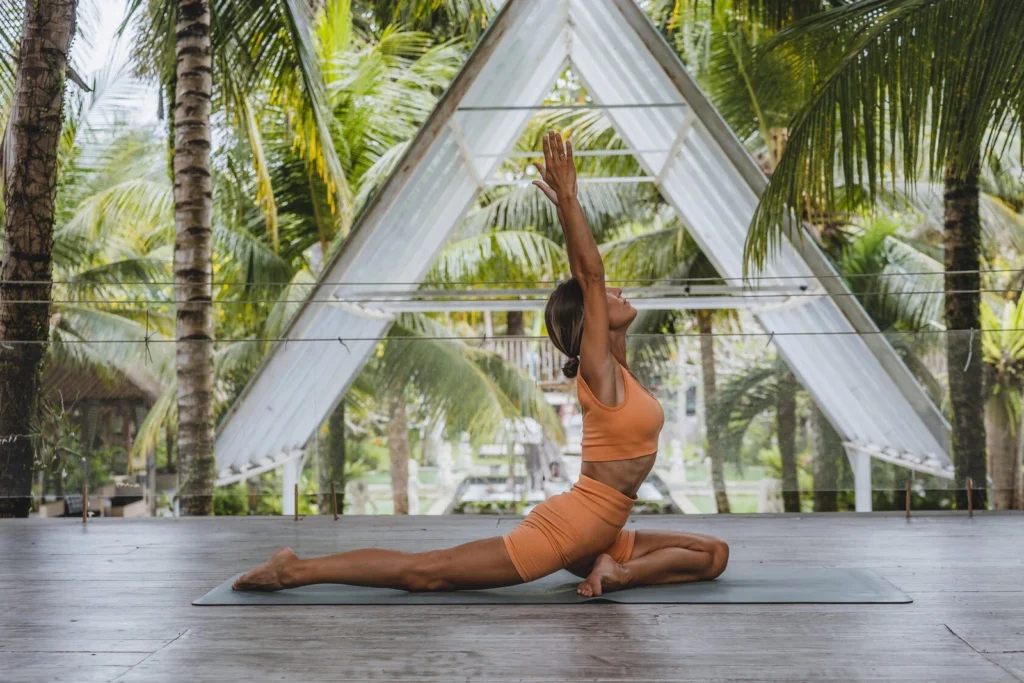
There is no universal answer. For many beginners a slower, more foundational approach makes it easier to learn postures, breathing, and alignment. But beginners can also start with Vinyasa or Ashtanga training when the entry requirements, teaching approach, and modifications are appropriate. |
What matters more than style is whether the program is designed to teach people who are new. Ask how modifications are handled, how much individual attention is available, and whether the entry requirements match where you actually are.
As one example: House of Om states that its 200-Hour Yoga Teacher Training in Koh Phangan welcomes all levels, beginners and beyond, and is designed for complete beginners, dedicated practitioners, and people curious to explore yoga. The school also states that teaching ambitions are not required to join — some students attend to deepen a personal practice.
You do not need to perform advanced postures before starting a teacher training. Curiosity, consistency, body awareness, and willingness to study matter considerably more.
Which Style Is More Physically Demanding?
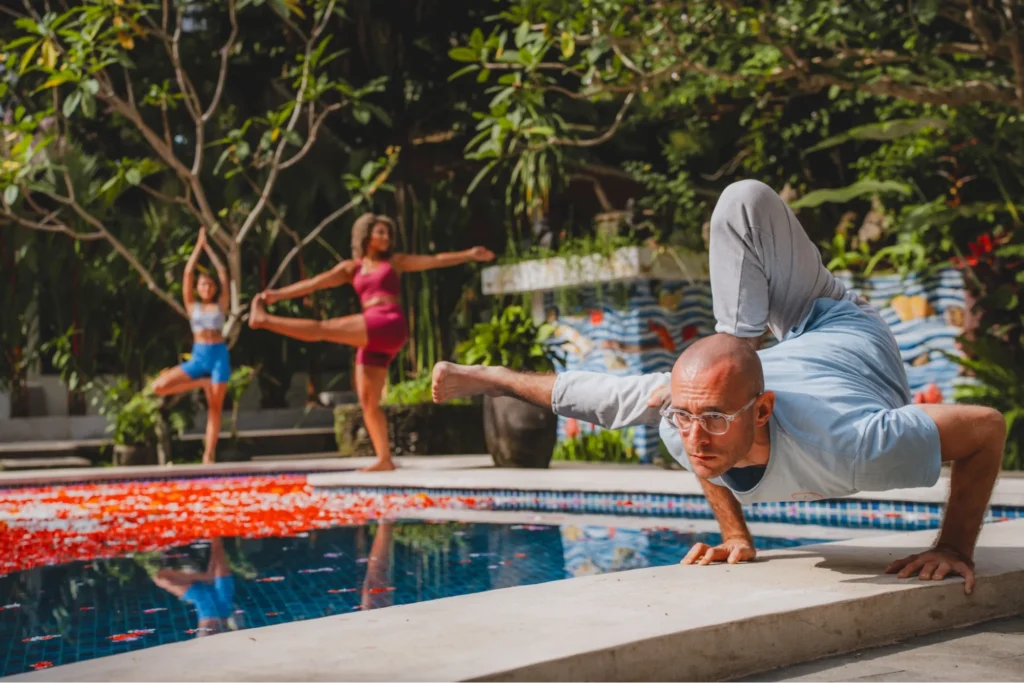
Intensity depends far more on the specific program than on the style label. The same style can feel entirely different depending on the teacher, the sequence, session length, your own level, what modifications are offered, and how frequently you practice.
As a general tendency:
| Style | Typical tendency |
|---|---|
| Hatha | Often slower paced, though sustained holds and alignment work can still be demanding |
| Vinyasa | Ranges widely, from gentle flowing classes to vigorous ones |
| Ashtanga | Typically structured, repetitive, and physically demanding |
This is not a ranking. A well-taught program in any style should provide modifications and safe guidance, and any intensive training will be more demanding than a weekly class regardless of the tradition it draws on.
Which Style Gives You the Most Freedom as a Teacher?
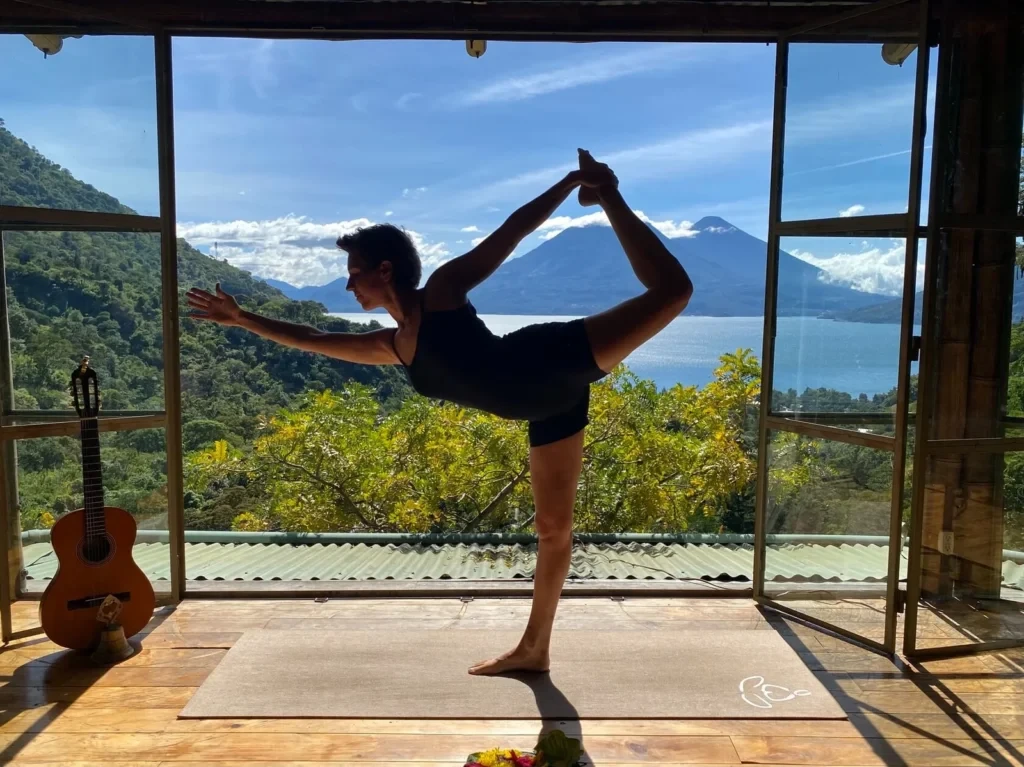
Each offers freedom, but within different boundaries.
- Hatha generally allows flexibility in selecting postures, pacing, and how long to hold each shape
- Vinyasa generally offers the widest scope for original sequencing and class design
- Ashtanga works within a defined method, where skill develops through how you teach the sequence rather than by changing it
It would be a mistake to conclude that Ashtanga teachers have no creativity. The craft sits in adjustment, observation, pacing, and knowing when a student is ready to progress — which is a different kind of skill, not an absence of one.
Which Style Offers the Best Career Opportunities?
| Direct answer
No yoga style guarantees better career opportunities. Teaching work depends on location, student demand, your teaching quality, communication, experience, niche, and business skills. The style you study influences which classes you are prepared to teach, not whether you will find work. |
What the style does affect is the kind of teaching you are ready for:
| Teaching context | Emphasis that can be useful |
|---|---|
| Beginners and private clients | Hatha foundations and clear instruction |
| Studio flow classes | Vinyasa sequencing skills |
| Traditional or Mysore-style settings | Ashtanga methodology |
| Retreats and mixed-level groups | Multi-style breadth |
| Online teaching | Clear verbal instruction and modification skills |
A multi-style foundation can broaden what a new teacher is prepared to offer, which may be useful when you do not yet know where you will end up teaching. That is a reasonable argument for breadth early on — not a guarantee of anything.
Single-Style vs. Multi-Style Yoga Teacher Training
| Feature | Single-style | Multi-style |
|---|---|---|
| Focus | Specialization in one method | Broader foundation across approaches |
| Curriculum | Deeper within one tradition | Exposure to several |
| Best for | Students with a clear specialization goal | Students still exploring |
| Flexibility afterward | More specialized | More adaptable across settings |
| Main advantage | Depth | Breadth |
| Main trade-off | Less exposure to alternatives | Less depth in any one method |
A single-style program makes sense if you already know your direction — an experienced Ashtanga practitioner, for instance, may want training rooted specifically in that lineage and methodology.
A multi-style program tends to make more sense at the 200-hour level if you are still working out which approach feels authentic to you. Specializing later, through a 300-hour or continuing education, is often a more informed decision than specializing before you have taught anyone.
How House of Om Combines Hatha, Vinyasa, and Ashtanga
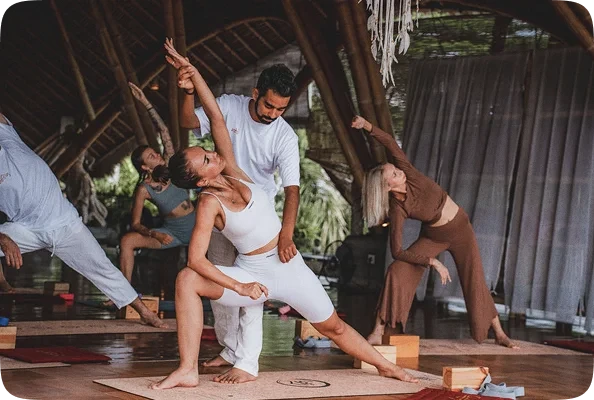
House of Om does not offer separate Hatha, Vinyasa, and Ashtanga certifications. Its teacher-training programs use a multi-style approach, with the exact emphasis varying by program and location.
That distinction matters when you are comparing schools. Some providers market three distinct style-specific courses; House of Om instead builds several traditions into one curriculum, which is a different proposition and suits a different kind of student.
House of Om’s 200-Hour Training in Koh Phangan, Thailand
The 200-Hour Yoga Teacher Training in Koh Phangan is described as rooted in Hatha and Vinyasa Flow, with elements of Ashtanga to deepen practice. The program page sets out a structure organized by style:
| Stage | Focus |
|---|---|
| Week 1 | Hatha yoga foundation |
| Week 2 | Vinyasa flow exploration |
| Week 3 | Ashtanga yoga and teaching mastery |
| End of training | Practical and theoretical exams |
That progression is a reasonable way to structure a multi-style course. Hatha establishes how postures are built. Vinyasa links them through breath and movement. Ashtanga applies both within a set sequence, paired with teaching work in the final week.
Alongside the asana focus, the program includes alignment workshops, hands-on adjustments, injury-prevention biomechanics, sunrise classes, afternoon labs, and mentor feedback, plus shatkarma, mantra and meditation, Yoga Nidra, Ayurveda, kirtan, sound healing, and Voice Activation.
Current dates, pricing, and availability should be checked on the official program page, as these change.
House of Om’s 200-Hour Hybrid Training
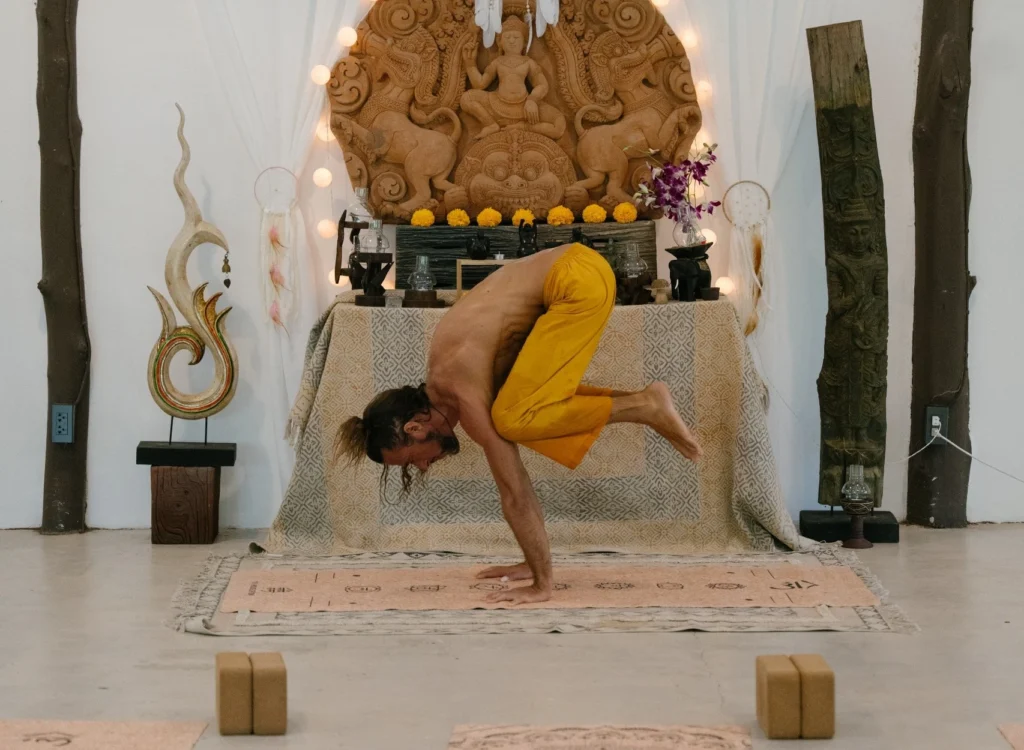
The 200-Hour Hybrid Yoga Teacher Training in Thailand combines self-paced online theory with a 10-day in-person immersion, including 9 nights of accommodation. Students can start online or start in person, and both components must be completed.
The style positioning is the same — rooted in Hatha and Vinyasa Flow with elements of Ashtanga — but the format differs from the full residential program. The in-person module covers Hatha and Vinyasa asana practice, alignment and hands-on adjustments, functional anatomy, class planning and sequencing, teaching methodology and practicum, mudras and bandhas, mantras and chanting, Yoga Nidra, and traditional shatkarma techniques.
This suits students who want multi-style exposure but cannot commit to a continuous residential block. It is a separate program with its own dates, pricing, and inclusions.
House of Om’s Rishikesh Programs
House of Om runs both 200-hour and 300-hour trainings in Rishikesh, India. Supplied program information for the 300-hour describes advanced asana, alignment, teaching methodology, sequencing, philosophy including the Yoga Sutras and Bhagavad Gita, anatomy, meditation, pranayama, Yoga Nidra, shatkarma, mantra, and advanced teaching practice.
India carries obvious appeal for students drawn to the tradition. Confirm the current curriculum details for either program on its own page before booking, since the specific structure varies between locations.
Advanced Multi-Style Study: the 300-Hour Hybrid in Pelaga, Bali
The 300-Hour Hybrid Yoga Teacher Training in Pelaga is designed for teachers who already hold a 200-hour certification. It combines a 14-day in-person immersion with self-paced online learning.
Supplied program information describes the online component as covering Hatha yoga and pranayama, philosophy, functional anatomy and injury management, sequencing theory, teaching methodology, and business foundations. The in-person component is described as including Hatha, Vinyasa, Ashtanga Vinyasa, and Mandala Vinyasa, with advanced sequencing, pranayama, bandha, shatkarma, hands-on adjustments, restorative therapeutics, trauma-informed facilitation, teaching labs, and practical feedback.
This is where multi-style study gets genuinely advanced. Mandala Vinyasa in particular is a sequencing approach that builds on a foundation rather than serving as an entry point — which is why the program is not suitable for someone without prior training.
Bali and Online Options
House of Om also runs 200-hour programs at several Bali locations, and offers online 200-hour and online 300-hour training. Curriculum details vary between locations, so check the specific program page rather than assuming one Bali site matches another. You can compare House of Om’s yoga teacher training locations if setting is part of your decision.
Online training is not identical to residential training. Hands-on adjustment in particular is difficult to learn without being in a room with someone, which is worth weighing if that skill matters to you.
Does the Style Affect Your Yoga Alliance Credential?
| Direct answer
No. Yoga Alliance credentials relate to registered schools and training levels rather than creating separate credentials for Hatha, Vinyasa, or Ashtanga. The style describes the curriculum; the credential describes the training level and the school’s registration. |
Two terms are worth keeping straight. A Registered Yoga School (RYS) is a school that meets Yoga Alliance’s standards. A Registered Yoga Teacher (RYT) is an individual who has completed training at such a school and applied for registration themselves.
Yoga Alliance’s published standards set out what a 200-hour program must cover across four categories — Techniques, Training and Practice; Anatomy and Physiology; Yoga Humanities; and Professional Essentials — rather than specifying which style a school teaches. Two schools can meet the same standard with quite different style emphases.
You can verify any school’s current status in the Yoga Alliance school directory. That check takes about two minutes and is worth more than any logo on a website.
How to Choose the Right Yoga Teacher Training
- Look at your current practice. Which classes do you attend consistently, and what do you enjoy about them?
- Define who you want to teach. Beginners, athletes, seniors, private clients, and online students have different needs.
- Read the actual curriculum, not the summary. Look for hour allocations rather than a topic list.
- Check how much supervised teaching practice is included, and who gives feedback.
- Confirm anatomy is applied to teaching rather than only memorized.
- Check that philosophy and ethics are covered, not just asana.
- Find out who is teaching your specific dates.
- Verify the school’s registration status independently.
- Compare accommodation, schedule, and total cost.
- Ask whether the program is single-style or multi-style, and how time is divided.
- Attend a class with the school if you can. Teaching style tells you more than a course description.
Questions to Ask Before Booking
- Is this a single-style or multi-style program?
- Roughly how much time is spent on each style?
- How many hours of supervised teaching practice are included?
- How is anatomy taught, and how much of it is applied to teaching?
- Are modifications taught for different bodies and levels?
- What are the entry requirements?
- What certification is awarded, and on what conditions?
- Is the school currently registered with Yoga Alliance?
- What accommodation and meals are included?
- What happens if I need to change my dates?
- What happens if illness prevents me from completing the training?
Frequently Asked Questions
Is Hatha or Vinyasa better for yoga teacher training?
Neither is universally better. Hatha may suit students who want detailed foundations and alignment work, while Vinyasa may suit students who enjoy breath-led movement and creative sequencing. A multi-style program can be useful if you want exposure to both.
Is Ashtanga harder than Vinyasa?
Ashtanga is often physically demanding because of its structured, repetitive practice, but difficulty varies by student, teacher, pace, and modifications. Vinyasa can also be highly demanding depending on how a class is designed.
Can beginners join Ashtanga yoga teacher training?
Some programs accept beginners; others expect prior experience. Check the entry requirements and confirm the program provides progressive instruction, modifications, anatomy, and safe teaching methods.
Does a 200-hour YTT teach Hatha, Vinyasa, and Ashtanga?
Many multi-style programs introduce more than one approach, but curriculum varies by school. House of Om’s current Thailand 200-hour program is described as rooted in Hatha and Vinyasa Flow with elements of Ashtanga. Review the official syllabus before enrolling.
Is Vinyasa derived from Ashtanga?
Modern Vinyasa shares breath-linked movement and sequencing influences with several dynamic traditions, including Ashtanga, but Vinyasa is not one standardized system. Different teachers and schools use very different sequencing approaches.
Which yoga style is best for beginners?
There is no universal answer. Hatha may offer a slower introduction to postures and alignment, while beginner-friendly Vinyasa or Ashtanga programs can also work when they provide appropriate modifications and instruction.
Which style is best for teaching online?
Both Hatha and Vinyasa can work well. Hatha’s slower pace makes detailed verbal instruction easier, while Vinyasa can create engaging guided movement. Your communication skills and ability to offer safe modifications matter more than the style.
Does Yoga Alliance certify specific yoga styles?
No. Yoga Alliance credentials relate to registered schools and training levels rather than creating separate credentials for individual styles. Always check a school’s current registration and the specific training being offered.
Can I teach multiple styles after a 200-hour training?
That depends on your curriculum and your actual training. A multi-style program may introduce several approaches, but completing a 200-hour course does not make anyone an expert in every style.
Is a multi-style YTT better than a single-style YTT?
Neither is universally better. Multi-style suits students who want breadth and are still exploring. Single-style suits someone with a clear commitment to a specific tradition and access to qualified mentorship in it.
What styles does House of Om teach?
House of Om uses multi-style approaches that vary by program and location. Its current Koh Phangan 200-hour program is described as rooted in Hatha and Vinyasa Flow with elements of Ashtanga. Rishikesh and the advanced Pelaga program have their own structures.
Which House of Om program should I choose?
Choose based on your experience, preferred format, location, and goals. Koh Phangan offers a 200-hour program and a hybrid option, Rishikesh offers 200- and 300-hour training, and Pelaga offers advanced hybrid training. Review each program page before booking.
Start Your Yoga Teacher Training
There is no best style, only the one that matches your body, temperament, and teaching goals. Hatha can give you precision and foundational clarity. Vinyasa can teach you to build a class. Ashtanga can develop discipline and progression within a defined method.
If you are still deciding, a multi-style 200-hour program lets you experience all three before committing to one — and specializing afterward, once you have taught a few classes, tends to be a better-informed choice than specializing before you start.
You can compare House of Om’s current training options across Thailand, Bali, Rishikesh, and online, or read our guide to yoga teacher training in Bali if you are weighing destinations.