
Who is a 300-hour yoga teacher training in Bali for?
A 300-hour yoga teacher training in Bali is generally intended for people who already hold foundational teacher training and want to deepen their teaching skills, practice, philosophy, anatomy, and sequencing. The exact prerequisite depends on the school and the current program requirements, so confirm before applying. |
A 300-hour yoga teacher training in Bali is generally intended for people who already hold foundational teacher training and want to go deeper — into teaching methodology, sequencing, anatomy, philosophy, and their own practice.
The exact prerequisite depends on the school. Many 300-hour programs are built for graduates of a 200-hour course, but requirements are set by individual providers rather than by a universal rule, so confirm what a specific program expects before applying.
This article is about the decision rather than the booking: who advanced training suits, when it makes sense, and what to compare between programs.
What Is a 300-Hour Yoga Teacher Training?
| Short answer
A 300-hour yoga teacher training is an advanced level of teacher education that typically builds on foundational training rather than replacing it. Structure and content vary considerably between schools, so two 300-hour programs may be quite different in emphasis. |
The difference from a 200-hour program is depth rather than repetition. For a fuller explanation of what advanced training covers, see our 300-hour yoga teacher training guide. This article stays on the question of whether it is the right next step for you.
Who Is a 300-Hour Yoga Teacher Training in Bali For?
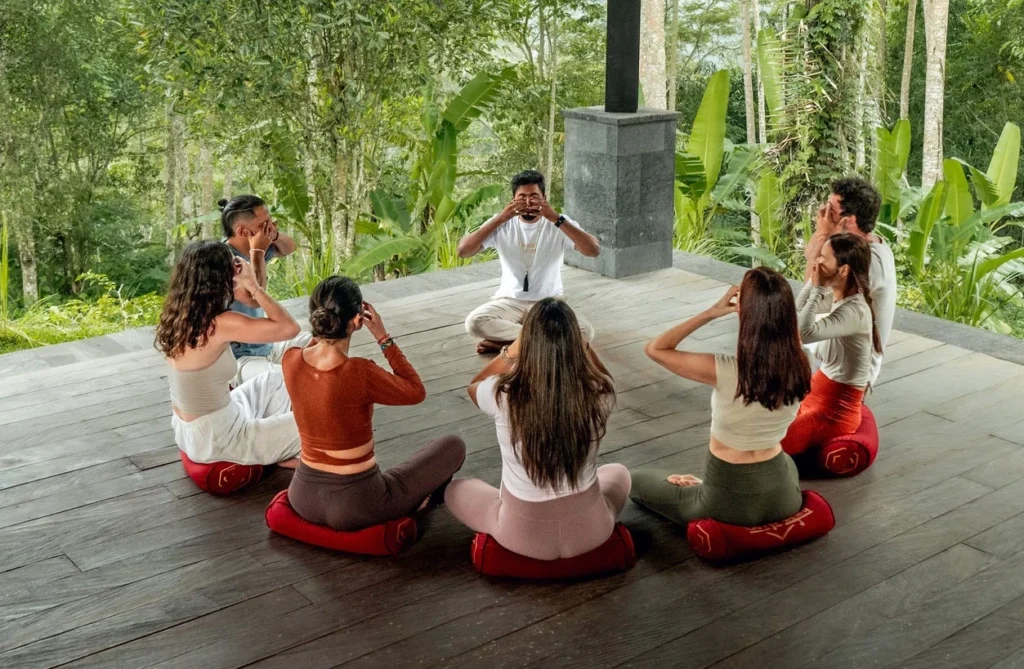
Several profiles tend to get the most from advanced training.
Graduates of a 200-hour teacher training
The most common starting point. A foundational course gives you the vocabulary and the basics; a 300-hour assumes both and builds from there.
Teachers who are already teaching
Arguably the group that benefits most. If you have taught real classes, you have encountered real problems — a student whose knee hurts in a posture, a sequence that lost the room halfway through, a cue nobody understood. Advanced training is far more useful when you arrive with questions rather than expecting to be given them.
Teachers wanting stronger sequencing and methodology
Foundational training covers sequencing; advanced training tends to go further into why a sequence works, how to build toward something, and how to adapt on the spot.
Practitioners seeking deeper anatomy and philosophy
Both subjects are introduced at the 200-hour level and can only be covered so far in that time. A 300-hour program allows more depth in each.
Teachers who want more supervised practice
More teaching with feedback is often the single most valuable component. If your foundational training was light on practicum, this may be the strongest reason to take advanced training.
Those considering an advanced credential pathway
Some teachers take a 300-hour course as part of working toward a higher registration level. That is one motivation among several, and not the only reason the training is worthwhile.
Anyone wanting depth rather than another foundational course
If you have completed a 200-hour and are considering a second one at the same level, a 300-hour usually makes better use of your time and money.
| Who it is generally not for
A 300-hour program is not usually designed for complete beginners. Where a school requires foundational training, that requirement exists because the curriculum assumes knowledge you would not yet have. |
Do You Need a 200-Hour YTT Before a 300-Hour YTT?
Usually, though it depends on the school. Many 300-hour programs are designed for students who have completed foundational 200-hour training, and their curriculum assumes it.
Prerequisites are set by individual providers, not by a single universal standard, so check what a specific program requires rather than assuming.
Where credential registration is part of your goal, Yoga Alliance’s requirements at the 500-hour level include documented teaching hours alongside training hours. That is worth knowing early, because it means the pathway is partly time spent teaching — something no course format can compress.
10. 200-Hour vs 300-Hour Comparison Table
| Area | 200-hour training | 300-hour training |
|---|---|---|
| Purpose | Foundational preparation to teach general classes | Advanced study building on existing training |
| Typical entry level | Varies — some schools accept beginners | Commonly requires foundational training |
| Teaching methodology | Introduced — cueing, demonstration, class management | Extended — refinement, adaptation, observation |
| Anatomy | Functional basics applied to teaching | Deeper study, often including injury awareness |
| Philosophy | Introduction to tradition and ethics | More extended study of texts and concepts |
| Sequencing | Building a coherent class | Advanced sequencing and progression design |
| Practicum | Supervised teaching within the course | Often more, with more detailed feedback |
| Depth of study | Broad coverage of foundations | Narrower and deeper |
| Format options | Residential, part-time, online, hybrid | Often modular or hybrid, varying by school |
| Time commitment | Varies by format | Varies more — frequently split across blocks |
These are general patterns. Schools structure both levels differently, so compare specific curricula rather than assuming the pattern holds.
What Can a 300-Hour Training Help You Develop?

- More refined sequencing, including building toward a peak and designing progressions
- Stronger observation — seeing what is happening in a room rather than delivering a plan
- Teaching methodology beyond the basics of cueing
- Greater confidence adapting a class when the people in front of you are not who you expected
- Deeper anatomy, often including injury awareness and contraindications
- More extended philosophy study
- Pranayama and meditation as teachable content rather than personal practice
- Clearer teaching voice and presence
- Professional reflection on your own habits and blind spots
None of this is guaranteed by attendance. What a program can offer is structured opportunity and feedback; what you take from it depends on how much you teach afterward.
Why Consider Bali for Advanced Training?

Practical reasons rather than romantic ones.
- Residential settings allow concentrated study without daily interruptions
- Distance from routine makes it easier to focus on material that needs sustained attention
- Bali has an established yoga-training ecosystem, which means more programs to compare
- An in-person immersion can be combined with online study, reducing time away
Bali is one option among several, and setting should not be the deciding factor. A beautiful location cannot compensate for thin curriculum or limited teaching practice — which is worth remembering when comparing programs that lead with photographs.
What Is Pelaga, Bali Like for Advanced Training?
Pelaga is in Bali, in a mountain setting rather than a coastal or central tourist area. House of Om uses Pelaga for its hybrid advanced training.
For advanced study, a quieter inland location has a practical logic. A 300-hour asks for sustained concentration on material that is more demanding than foundational content, and fewer distractions helps. The trade-off is less immediate access to the amenities of busier areas.
Specific details about the setting — facilities, accommodation, and surroundings — should be confirmed on the current program page rather than assumed.
How Hybrid 300-Hour Training Works
A hybrid program splits learning between online study and an in-person component. Typically the theory-heavier material is delivered online, and the practice, adjustment, and teaching work happens in person, where it needs to happen.
House of Om’s 300-hour hybrid yoga teacher training in Bali follows this structure, combining online learning with an in-person component in Pelaga. The current balance between the two, along with dates and inclusions, should be checked on the program page.
Who may prefer a hybrid format?
- Working teachers who cannot take a long uninterrupted block away
- International students managing travel cost and time
- People with family or work commitments that rule out extended absence
- Those who prefer theory at their own pace and practice in person
- Anyone who wants to spread the financial commitment differently
Hybrid is not better than residential — it is a different fit. The honest question is whether you complete self-directed study reliably. If you do, hybrid works well. If you do not, a residential format may finish faster in practice.
What to Compare Before Choosing a 300-Hour Program in Bali

- Prerequisites — what foundational training is required, and in what form
- Curriculum depth — what is actually covered beyond the 200-hour level
- Teaching practice — how many hours, observed by whom, with what feedback
- Anatomy — how far it goes and whether it is applied to teaching
- Sequencing — how much time is dedicated to it
- Philosophy — depth and whether it connects to teaching situations
- Assessment — what you are assessed on and what happens if you struggle
- Online and in-person balance — what is delivered where
- Teacher qualifications — who is leading your specific dates
- Accommodation — type, nights, and what is included
- What the fee covers, and what it excludes
- Cancellation and rescheduling terms
- Certificate and any registration pathway
- Current dates and availability
- Total cost including travel
- Travel logistics to the specific location
Items eight through fifteen change over time. Verify each on the current program page rather than relying on any article, including this one.
Questions to Ask Before Enrolling
- Is 200-hour training required, and does it need to be from a particular type of school?
- How much of the program is online, and how much is in person?
- How is teaching practice structured and assessed?
- Who gives feedback, and how soon?
- What is included in the fee, and what is not?
- Is accommodation included, and for how many nights?
- What certificate is issued, and on what conditions?
- Are dates fixed, or is there flexibility in completing the components?
- What is the cancellation policy?
- What should I complete before arriving?
Send these as one email. How specifically and how quickly a school answers tells you a good deal about how it runs its training.
How House of Om’s 300-Hour Hybrid in Bali Fits
House of Om offers a 300-hour Hybrid Yoga Teacher Training in Pelaga, Bali. The program combines online learning with an in-person component in Bali and is positioned as advanced study rather than a foundational course.
Current dates, pricing, accommodation, curriculum breakdown, and inclusions are dynamic. Review them on the 300-hour hybrid yoga teacher training in Bali page before making a decision, since anything quoted elsewhere may be out of date.
If you are still comparing levels and locations, the full range of House of Om yoga teacher training programs shows how the foundational and advanced options relate.
11. “Is This Right for You?” Checklist
A 300-hour training may be a good next step if:
❑ You already hold foundational teacher training
❑ You have taught at least some classes and have real questions
❑ You want deeper teaching methodology rather than broader coverage
❑ You want more supervised practice and feedback
❑ You can commit to the format, including any self-directed portion
❑ You have checked the prerequisites and meet them
It may not be the right next step if:
❑ You have no foundational training and the school requires it
❑ You are primarily looking for a retreat rather than a course
❑ You cannot realistically complete the online component
❑ You have not yet taught, and would benefit more from teaching first
❑ You have not confirmed what the program actually requires of you
That fourth point is worth sitting with. Advanced training rewards people who arrive with experience. If you graduated recently and have not taught much, a period of teaching first may make the same course considerably more valuable.
FAQs
What is a 300-hour yoga teacher training?
It is an advanced level of yoga teacher education that typically builds on foundational 200-hour training. Content and structure vary by school, but it generally goes deeper into teaching methodology, sequencing, anatomy, and philosophy rather than repeating foundational material.
Who should take a 300-hour yoga teacher training?
It is generally designed for people who already hold foundational teacher training, particularly those already teaching. Teachers who have encountered real problems in real classes tend to get the most from it, since advanced training is more useful when you arrive with questions.
Do I need a 200-hour YTT before a 300-hour YTT?
Usually, though, prerequisites are set by individual schools rather than a universal rule. Many 300-hour programs assume foundational training in their curriculum. Confirm what a specific program requires before applying.
Is a 300-hour YTT harder than a 200-hour YTT?
It is generally more demanding intellectually, because it assumes foundational knowledge and goes deeper. Whether it feels harder depends on your experience — teachers who have been teaching often find advanced material easier to absorb than they expected.
What do you learn in a 300-hour YTT?
Content varies by school. Common areas include advanced sequencing, refined teaching methodology, deeper anatomy including injury awareness, extended philosophy, pranayama and meditation as teachable content, and more supervised teaching with feedback.
How long does a 300-hour yoga teacher training take?
It varies more than a 200-hour, because advanced training is often modular or hybrid. It may run as one continuous intensive, across separate blocks over months, or split between online and in-person components. Check the specific program.
Is a 300-hour YTT in Bali worth it?
That depends on your goals and readiness. It tends to be worthwhile for teachers who want depth and more supervised practice. Setting matters less than curriculum, teaching practice, and who is teaching — compare those before comparing locations.
What is a hybrid 300-hour yoga teacher training?
A format that splits learning between online study and an in-person component. Theory-heavier material is typically delivered online, with practice, adjustment, and teaching work happening in person. It reduces time away without reducing the training.
Does a 300-hour YTT lead to RYT 500?
It can form part of that pathway, but not automatically. Yoga Alliance requirements at the 500-hour level include documented teaching hours alongside training hours, and registration is an application you make yourself. Confirm current requirements directly.
What should I check before choosing a 300-hour YTT in Bali?
Prerequisites, curriculum depth beyond the foundational level, hours of supervised teaching, who is teaching your dates, the online and in-person balance, what the fee covers, accommodation, cancellation terms, and the certificate issued.
Conclusion
A 300-hour yoga teacher training is an advanced step rather than a bigger version of a foundational course. It suits people who already have training behind them, ideally some teaching experience, and who want depth in methodology, sequencing, anatomy, and philosophy.
The right program depends on prerequisites, how much supervised teaching is included, the balance between online and in-person components, and whether the format matches how you actually study. Setting comes after all of that.
If advanced training in Bali fits where you are, review the current 300-hour hybrid yoga teacher training in Bali program page for the latest structure, dates, and inclusions.