
A 200-hour yoga teacher training in Thailand is a foundational program covering yoga practice, anatomy and physiology, philosophy, teaching methodology, and supervised teaching, assessed before a certificate is issued.
The three things people most want to know before enrolling are what the entry requirements are, what “200 hours” actually means, and what certificate they end up with. This guide covers all three.
| The distinction worth reading first
A 200-hour training, a school-issued certificate, a Registered Yoga School designation, an individual teacher registration, and legal permission to work in a country are five separate things. They connect in sequence but none of them automatically produces the next. |
What Is a 200-Hour Yoga Teacher Training?
It is the foundational level of yoga teacher education — the standard qualification for someone preparing to teach general classes. It combines personal practice with the subjects a teacher needs that a practitioner does not: anatomy applied to instruction, sequencing, cueing, and supervised teaching with feedback.
“200 hours” refers to the total required training time. How those hours are delivered and what counts toward them depends on the credentialing framework and the school, which is where most of the confusion sits.
What Are the Requirements for a 200-Hour YTT in Thailand?
| Direct answer
Requirements vary by school. Many programs ask applicants to meet the school’s own age, language, attendance, and personal-practice expectations. Advanced postures and previous teaching experience are not universal requirements. There is no Thailand-wide standard, so check the specific program. |
That last point matters. Articles that state flat requirements — “you must be 18,” “you need six months of practice” — are describing individual schools’ policies as though they were universal rules. They are not.
Previous yoga experience
Some schools accept complete beginners. Others expect an established personal practice, sometimes specifying a duration. Neither approach is wrong; they suit different students.
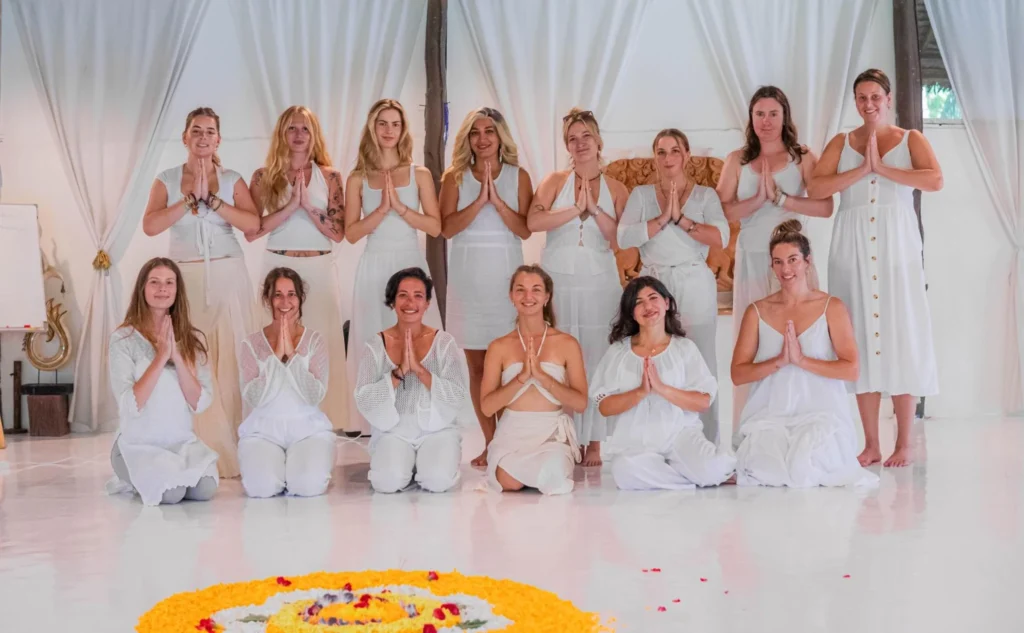
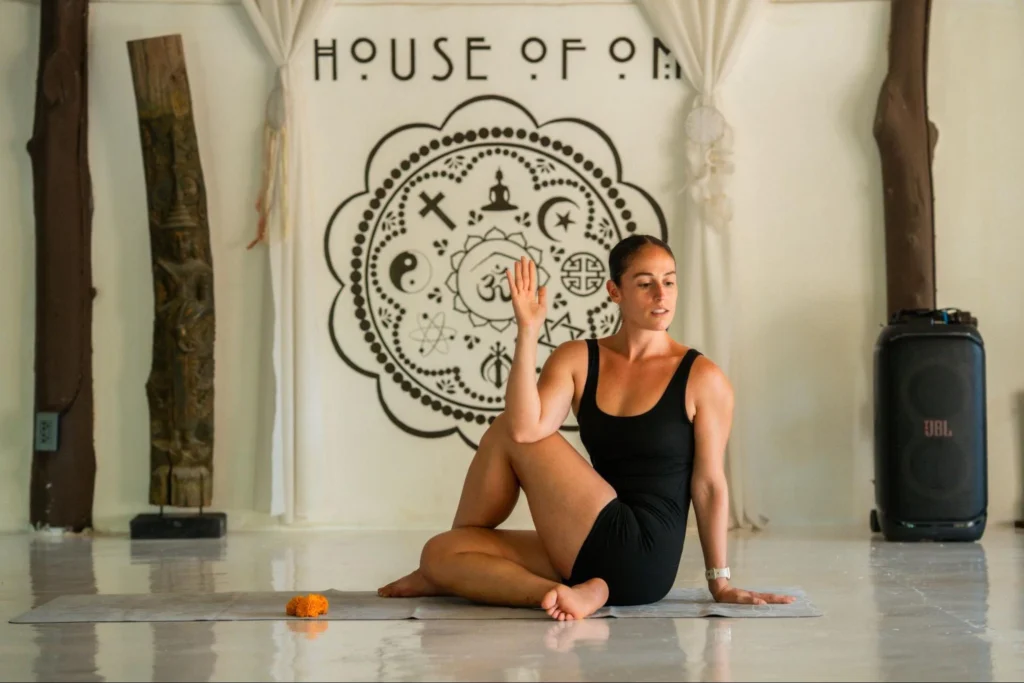
House of Om states that its 200-hour yoga teacher training in Koh Phangan welcomes all levels, beginners and beyond, and is designed for complete beginners, dedicated practitioners, and people curious to explore yoga. The school also states that teaching ambitions are not required to join. That is House of Om’s stated policy, not a general rule.
Age requirements
Schools set their own minimum age. Check the specific program rather than assuming a standard figure — published articles often state one without attributing it to any particular school or governing body.
Language
International programs in Thailand are typically taught in English. You need enough comprehension to follow anatomy terminology, philosophy lectures, and teaching feedback — which is a higher bar than conversational English, since much of the vocabulary will be new regardless of your first language.
Physical readiness
An intensive residential training involves daily practice, extended sitting, repetition, and a full schedule, often in heat. It is demanding, though not in the way people expect — the difficulty comes from accumulation across consecutive days rather than from any single session.
Disclose injuries or physical limitations to the school before booking rather than on arrival, and follow qualified professional guidance about what is appropriate for you.
Attendance and commitment
Most programs have attendance requirements and specify what happens if sessions are missed. Ask for these in writing. A school that cannot say what its attendance policy is has not thought carefully about assessment either.
Do You Need Previous Yoga Experience?
Often not, though it depends on the school. What you generally do not need:
- Advanced flexibility
- Inversions, arm balances, or splits
- Previous teaching experience
- A particular body type or fitness level
What tends to matter more:
- Consistency — regular practice beforehand beats intensive practice
- Openness to being corrected in front of other people
- Willingness to study material that is not physical
- Body awareness, which is different from ability
- Capacity to keep up with a full daily schedule
Flexibility is not what a teacher training assesses. You are learning to instruct safely and adapt postures for bodies unlike your own, which is a different skill from performing them.
What Does a 200-Hour YTT Include?
Yoga Alliance’s published standards organize a 200-hour program across four educational categories rather than prescribing a style.
| Category | What students study |
|---|---|
| Techniques, Training and Practice | Asana, pranayama, meditation, and the practices themselves |
| Anatomy and Physiology | Functional anatomy, joint actions, individual variation, safe adaptation |
| Yoga Humanities | History, philosophy, ethics, and the tradition behind the practice |
| Professional Essentials | Teaching methodology, sequencing, practicum, and professional conduct |
Two schools can meet the same standard with very different style emphases, which is why the category framework tells you more than a course title does.
Techniques, training and practice
Usually the largest portion of the day. Postures studied in more depth than a general class allows, plus breath practices and meditation — including when a technique is appropriate and when it should be avoided.
Anatomy and physiology
Not muscle-name memorization. The purpose is understanding that bodies differ, so a single instruction cannot be correct for everyone. A responsible program also teaches the difference between unfamiliar effort and pain that signals something wrong.
Yoga humanities
History, philosophy, and ethics, ideally connected to real teaching situations — student autonomy, boundaries, cultural respect, and consent around physical adjustments — rather than treated as abstract material.
Professional essentials
Class planning, sequencing, cueing, demonstration, observation, and supervised teaching with feedback. This is the part that determines whether you can lead a room afterward, and the part most worth interrogating when comparing schools.
What Actually Counts Toward the 200 Hours?
This is the question most articles skip, and it is the most useful one to understand before paying a deposit.
Under the RYS 200 standards introduced in February 2020, Yoga Alliance requires all 200 hours to be classroom hours, with a specific allowance for online delivery.
| Rule | What it means |
|---|---|
| All 200 must be classroom hours | Instructional time with a trainer, not independent study |
| Up to 40 hours may be online classroom hours | A capped allowance, not an open substitution |
| Maximum 20 online hours in Anatomy and Physiology | The online allowance is capped by category |
| Maximum 20 online hours in Yoga Humanities | The remaining half of the allowance |
| Homework does not count | Assignments are additional to the 200 |
| Personal practice does not count | Your own practice sits outside the instructional total |
| Volunteer work and public classes do not count | Neither counts as instructional hours |
| 14 hours per day maximum | A cap on how compressed a program can be |
| Why this matters when comparing programs
A course that appears to reach 200 hours by counting reading, assignments, and personal practice is not counting the way the registry counts. This gives you one precise question to ask any school: how are your 200 hours allocated between in-person classroom hours, online classroom hours, and everything else? |
|
Get the answer in writing. A school delivering a genuine 200 classroom hours will have that breakdown available; one that cannot produce it is telling you something.
What Does a Typical Day Look Like?
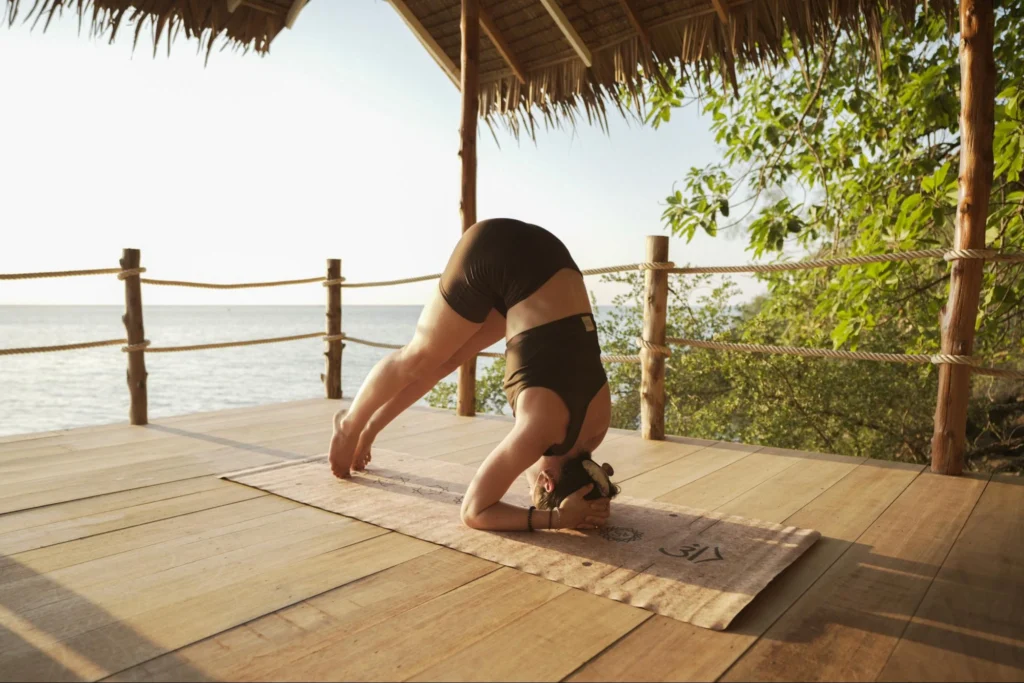
There is no universal Thailand YTT schedule. Programs differ considerably, so ask for the full timetable before booking travel.
Example structure — exact schedules vary by school
| Time of day | Typical activity |
|---|---|
| Early morning | Meditation, pranayama, or cleansing practices |
| Morning | Main asana practice |
| Late morning | Anatomy, philosophy, or theory |
| Midday | Meals and rest |
| Afternoon | Teaching methodology, sequencing, alignment |
| Late afternoon | Practicum or adjustment work |
| Evening | Restorative practice, meditation, or self-study |
That is a general pattern, not any specific school’s timetable.
House of Om’s published Koh Phangan schedule
| Time | Session |
|---|---|
| 06:00 – 06:15 | Shatkarma |
| 06:15 – 06:30 | Chanting |
| 06:30 – 07:45 | Asana and pranayama |
| 08:00 – 08:45 | Morning lab |
| 08:45 – 10:00 | Breakfast |
| 10:00 – 12:00 | Jnana yoga |
| 12:00 – 13:15 | Yoga Nidra |
| 13:15 – 14:30 | Lunch |
| 14:30 – 15:30 | Teaching methodology |
| 15:30 – 16:45 | Alignment and adjustment |
| 17:00 – 18:00 | Evening sadhana |
House of Om notes that this schedule is subject to change at the teacher’s discretion.
How Long Does a 200-Hour YTT in Thailand Take?
It depends on format. Residential programs are typically intensive and continuous. Hybrid programs spread theory over a longer window with a shorter in-person block. Modular formats spread the whole thing further.
House of Om’s Thailand residential program runs 20 days; its hybrid includes a 10-day in-person component. Other schools differ, and calendar length alone tells you little — what matters is how the classroom hours are distributed and how much supervised teaching is included.
Residential vs. Hybrid
| Feature | Residential | Hybrid |
|---|---|---|
| Main format | In-person intensive | Online plus in-person |
| Flexibility | Lower | Higher |
| Immersion | High | Concentrated in the in-person block |
| Daily teacher access | Throughout | During the immersion |
| Community | Sustained | Concentrated, then remote |
| Practical teaching | Spread across the course | Within the in-person component |
| Best suited to | Those who can step away continuously | Those with work or family commitments |
House of Om’s hybrid yoga teacher training in Thailand combines self-paced online study with a 10-day in-person immersion in Koh Phangan, including 9 nights of accommodation and two meals per day on training days. Students can start online or start in person, and both components must be completed before the certificate is issued.
What Certification Do You Receive?
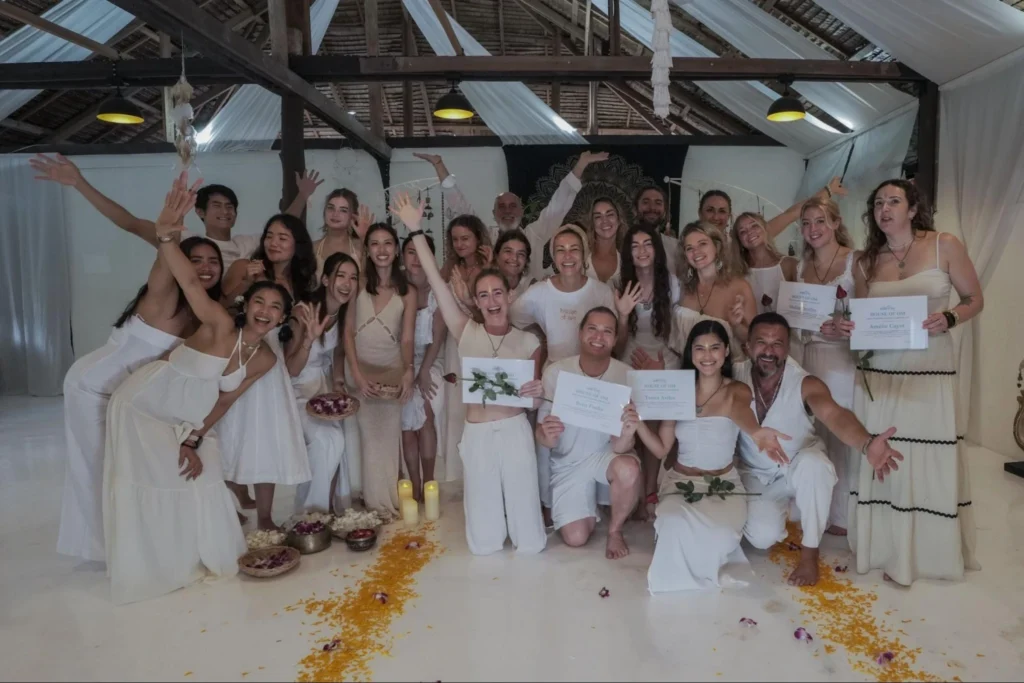
After meeting the program requirements, the school issues a completion certificate. Whether that leads to an individual registration is a separate step you take yourself.
| Term | Applies to | Meaning | What it does not mean |
|---|---|---|---|
| School certificate | The graduate | Proof you completed that school’s program | Not an external credential |
| RYS 200 | The school | Registered Yoga School at the 200-hour level | Does not register you automatically |
| RYT 200 | The individual | Registered Yoga Teacher, applied for by you | Not a government license |
| RYT 500 | The individual | Higher-level registration pathway | Not required for entry-level teaching |
| Is a 200-hour certificate the same as RYT 200?
No. The school issues the certificate when you complete its program. RYT 200 is an individual registration with Yoga Alliance that you apply for afterward, with its own application and fee. Graduating from a registered school does not make you an RYT. |
|||
Verify any school’s current status in the Yoga Alliance school directory before paying a deposit. For the full credential picture — fees, employer expectations, and specialized qualifications — see our guide to yoga certification requirements in Thailand.
House of Om states that successful completion of its Thailand program earns an internationally recognized Yoga Alliance certification, following practical and theoretical exams.
Does 200 Hours Make You a Yoga Teacher?
| Direct answer
It gives you a foundational teacher-training qualification. It does not guarantee employment, competence in every specialty, or legal permission to work in a particular country. Competence comes from teaching afterward, with feedback, over time. |
A general 200-hour training also does not qualify anyone to teach specialties such as prenatal yoga, children’s yoga, yoga therapy, or trauma-informed approaches. Those require their own training, and teaching outside your scope is a professional and safety issue as well as an insurance one.
Can You Teach Yoga in Thailand After Completing a 200-Hour YTT?
Training in Thailand and working in Thailand are different questions. Thailand’s Ministry of Foreign Affairs states that foreigners entering Thailand are not permitted to work, regardless of their type of visa, unless they are granted a work permit, and must hold the correct type of visa to be eligible to apply for one.
No yoga qualification changes that. Certification answers whether you have completed recognized training; work authorization is granted separately by national authorities.
| Important
Immigration, work-permit, tax, and employment requirements can change and may depend on your nationality, visa status, employer, and type of work. If you plan to teach for payment in Thailand, confirm current requirements with Thai immigration, the relevant embassy or consulate, the Department of Employment, your employer, or a qualified local professional before accepting work. This is general information, not legal advice. |
How Much Does a 200-Hour YTT in Thailand Cost?
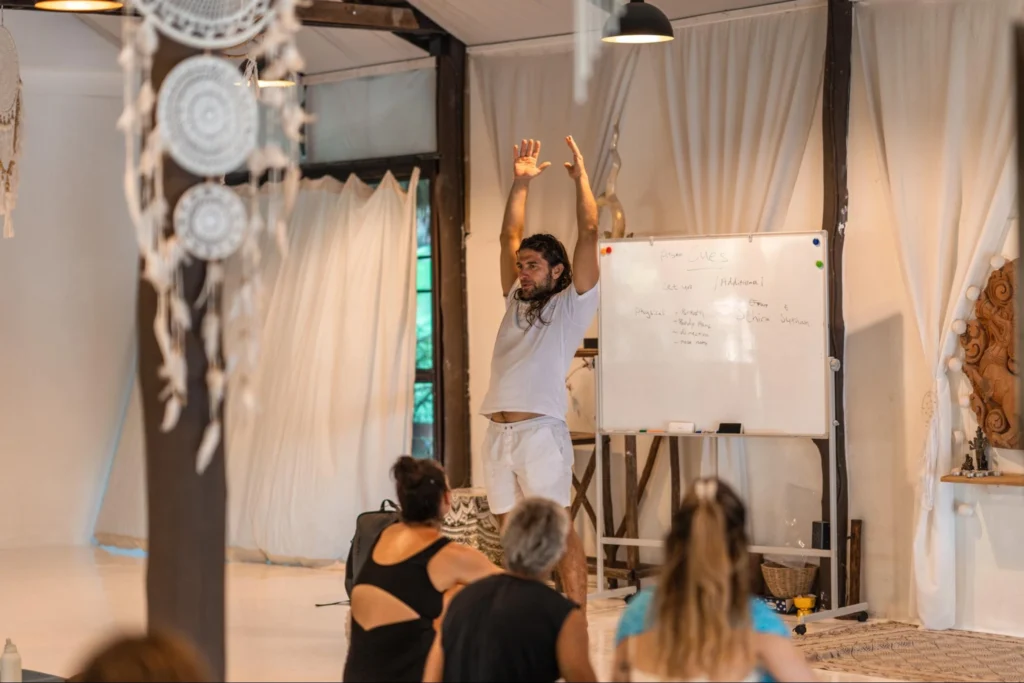
There is no single Thailand-wide price. Costs depend on the school, location, duration, accommodation standard, meals, facilities, teacher experience, and format.
Compare what is covered rather than headline figures. Ask whether the quote includes tuition, accommodation and for how many nights, meals and on which days, course materials, assessment fees, transfers, equipment, and taxes — then add flights, travel insurance, and your own registration fee if you plan to register.
For House of Om, pricing varies by accommodation package and by intake. Check the current program page for live tuition and room options rather than relying on any figure quoted elsewhere.
What Is Usually Included?
| Item | Typical status across providers |
|---|---|
| Tuition | Almost always included |
| Accommodation | Varies — check nights and room type |
| Meals | Varies — check how many per day and on which days |
| Course materials | Usually included, but confirm |
| Assessments | Usually included; check for separate fees |
| Certificate | Usually on successful completion |
| Equipment and props | Varies — ask before buying a mat |
| Transfers | Often excluded |
This describes common industry practice, not confirmed House of Om inclusions. For House of Om’s Thailand programs, the residential option includes 19 nights at a beachfront resort with fresh, Ayurvedic-inspired vegetarian meals; the hybrid includes 9 nights and two meals per day on training days. Those figures belong to their own programs and do not carry across.
House of Om’s 200-Hour Yoga Teacher Training in Thailand
| Detail | Information |
|---|---|
| Program | 200-Hour Yoga Teacher Training |
| Location | Koh Phangan, Thailand |
| Format | In-person residential |
| Duration | 20 days |
| Curriculum type | Multi-style — rooted in Hatha and Vinyasa Flow, with elements of Ashtanga |
| Structure | Week 1 Hatha foundation, Week 2 Vinyasa flow, Week 3 Ashtanga and teaching mastery |
| Assessment | Practical and theoretical exams at the end of training |
| Entry level | All levels welcome, beginners and beyond |
| Accommodation | 19 nights at a beachfront resort |
| Meals | Fresh, Ayurvedic-inspired vegetarian meals with organic ingredients |
| Certification | Internationally recognized Yoga Alliance certification on successful completion |
The training includes daily practice, alignment workshops, hands-on adjustments, injury-prevention biomechanics, sunrise classes, afternoon labs, and mentor feedback, alongside shatkarma, mantra and meditation, Yoga Nidra, Ayurveda, kirtan, sound healing, and Voice Activation.
Current dates, pricing, and room availability change by intake and should be checked on the program page.
Who it may and may not suit
It may suit someone wanting a multi-style foundation, a residential setting in Koh Phangan, and exposure to Hatha, Vinyasa, and Ashtanga within one curriculum. It is likely not the right fit for someone seeking a single-lineage specialist program, a purely online credential, a specialty qualification, or a training that comes with a work arrangement attached.
How to Choose a 200-Hour YTT in Thailand
- Verify the school’s current registration status independently.
- Request the full curriculum, not the marketing summary.
- Ask how the 200 hours split between in-person and online classroom delivery.
- Ask how many hours of supervised teaching practice are included.
- Find out who is teaching your specific dates.
- Confirm assessment and attendance requirements in writing.
- Ask about group size.
- Confirm accommodation type and number of nights.
- Confirm meals — how many per day, on which days.
- Calculate total cost including exclusions.
- Read the cancellation and rescheduling terms.
- Research work authorization separately if you intend to teach in Thailand.
Red Flags When Choosing a Program
- Guaranteed employment or income after graduation
- Claims that certification grants a work permit
- No named teachers before you book
- No detailed syllabus provided before payment
- Vagueness about how the 200 hours are delivered
- Certification described as automatic on attendance
- No clear assessment or graduation requirements
- Little or no supervised teaching practice
- Therapeutic or medical claims without appropriate qualifications
- Unclear pricing, or fees appearing after the deposit
- No written cancellation policy
- Pressure to pay quickly
The pattern: weak programs are vague about what costs them money — teacher time, small groups, individual feedback — and specific about what costs nothing, like the setting.
What Styles Can You Study?
Programs vary. Some are dedicated to a single tradition; many are multi-style. Hatha typically emphasizes foundations and alignment, Vinyasa breath-led sequencing, and Ashtanga established sequences and progression.
House of Om’s Thailand programs use a multi-style curriculum incorporating Hatha, Vinyasa Flow, and elements of Ashtanga, structured across three weeks by style in the residential format.
Why Koh Phangan?
House of Om describes its Koh Phangan location as a beachfront resort on the island’s peaceful shore, with a tropical setting, palm trees, sea breeze, and rooms offering access directly to the sand.
For a residential program the practical benefit is reduced friction: short distances between accommodation and practice space, and genuinely restful recovery time. The trade-off is access — an island means more travel time and fewer services nearby than a city location. That suits some people and not others.
What Can You Do After a 200-Hour YTT?
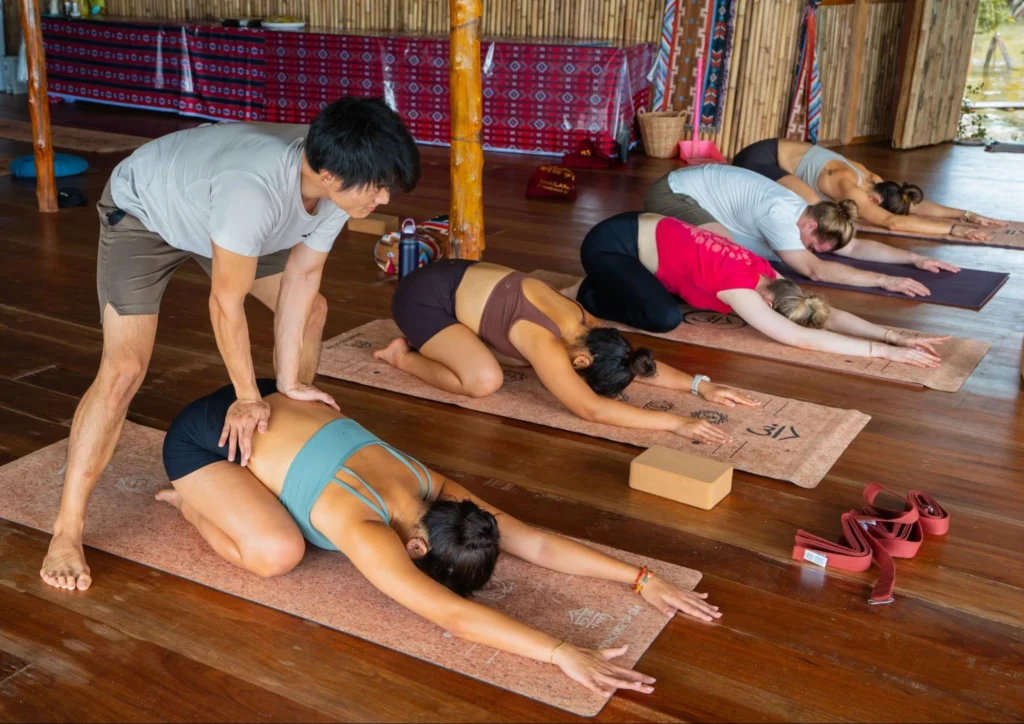
Possible paths include studio classes, retreat teaching, hotel and resort work, private clients, online classes, community and corporate sessions, and further specialization. What improves employability is teaching experience, communication, reliability, references, and honesty about your scope.
On further study: the 200-hour is foundational, the 300-hour is advanced training taken afterward, and together they form the 500-hour pathway. Most new teachers do not need more than 200 hours to begin. If travel is not currently possible, House of Om also offers an online 200-hour program.
Pre-Enrollment Checklist
❑ School verified in the Yoga Alliance directory
❑ The exact course matches the registered program
❑ Format confirmed — residential, hybrid, or online
❑ Hour breakdown received: in-person, online, and everything else
❑ Full syllabus received
❑ Supervised teaching hours confirmed
❑ Assessment and attendance requirements in writing
❑ Lead teachers named for your dates
❑ Group size confirmed
❑ Certificate wording confirmed
❑ RYT eligibility understood, with the separate fee budgeted
❑ Accommodation and meals confirmed
❑ Total price confirmed with exclusions listed
❑ Cancellation terms read in full
❑ Insurance arranged before teaching
❑ Work authorization researched separately if teaching in Thailand
Start Your Training in Thailand
If a multi-style residential foundation in Koh Phangan fits what you are looking for, review House of Om’s 200-hour yoga teacher training in Thailand and its hybrid option, or compare all current programs. You can also read student experiences at House of Om before deciding.
FAQs
What are the requirements for a 200-hour YTT in Thailand?
Requirements vary by school. Programs generally require completing the full curriculum, meeting attendance requirements, participating in teaching practice, and passing assessments. Entry criteria such as age, language, and prior practice differ by provider, so check the specific program.
Do I need yoga experience to join a 200-hour YTT?
Not always. Some schools accept complete beginners; others expect an established practice. House of Om states that its Thailand program welcomes all levels, beginners and beyond. Advanced postures and flexibility are not requirements anywhere.
How many hours is a 200-hour yoga teacher training?
Two hundred training hours. Under Yoga Alliance’s RYS 200 standards, all 200 must be classroom hours, with up to 40 delivered as online classroom hours — capped at 20 in Anatomy and Physiology and 20 in Yoga Humanities.
What does a 200-hour YTT include?
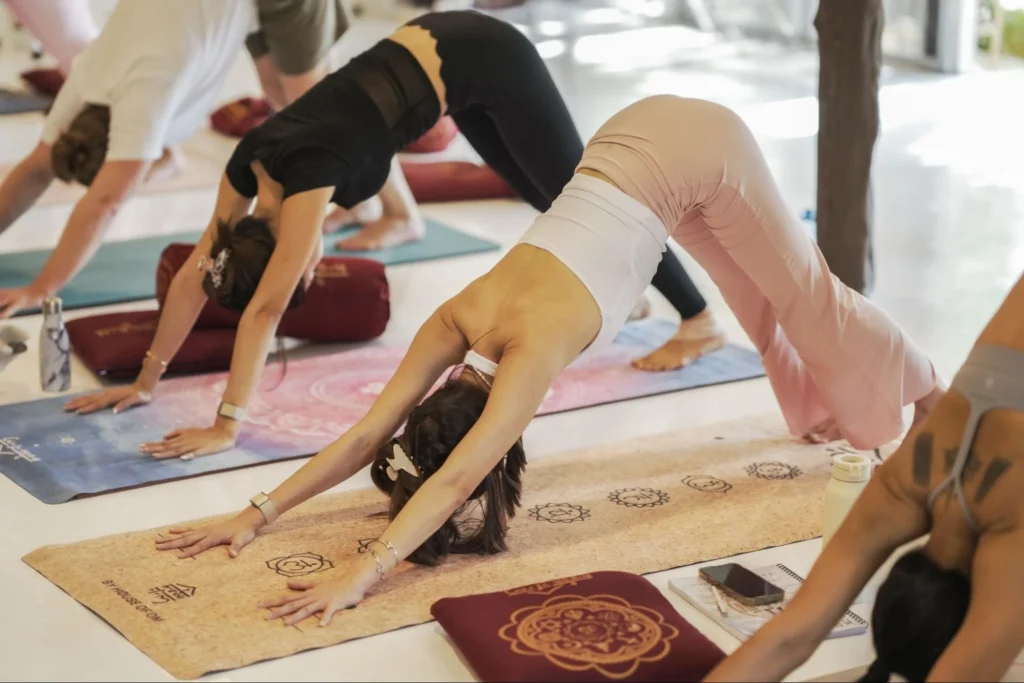
Yoga Alliance organizes the curriculum across four categories: Techniques, Training and Practice; Anatomy and Physiology; Yoga Humanities; and Professional Essentials. Within those, expect asana, pranayama, meditation, anatomy, philosophy, ethics, teaching methodology, sequencing, and supervised practicum.
Is a 200-hour certificate the same as RYT 200?
No. The school issues the completion certificate. RYT 200 is a separate individual registration with Yoga Alliance that you apply for yourself after graduating, with its own application and fee.
What is RYS 200?
Registered Yoga School at the 200-hour level. It refers to the school or program, not the individual. A school holding RYS 200 status can offer training that may make graduates eligible to apply for RYT 200 registration.
How long does a 200-hour YTT in Thailand take?
It depends on format. House of Om’s Thailand residential program runs 20 days; its hybrid includes a 10-day in-person component alongside self-paced online study. Other schools vary, so check the specific program.
Can beginners join a 200-hour YTT?
Many programs accept beginners, though entry requirements vary by school. Ask how modifications are taught, how injuries are handled, and how much individual attention is available during practicum — those answers matter more than the stated entry criteria.
Can I teach yoga after completing a 200-hour YTT?
It is the standard entry-level qualification, but graduation does not guarantee employment. Studios set their own hiring criteria and often consider teaching experience, an audition, insurance, and references alongside the certificate.
Can I teach yoga in Thailand after completing YTT?
Only with appropriate authorization. Thailand’s Ministry of Foreign Affairs states that foreigners are not permitted to work regardless of visa type unless granted a work permit, and must hold the correct visa to be eligible to apply.
Is a hybrid 200-hour YTT valid?
It depends on the school and how the hours are delivered. Yoga Alliance permits up to 40 of the 200 hours as online classroom hours within category caps. Ask any hybrid provider for the exact split before enrolling.
How much does a 200-hour YTT in Thailand cost?
There is no single Thailand-wide price. Costs depend on school, accommodation, meals, duration, and format. Compare itemized inclusions rather than headline figures, and check the current program page for live pricing.
Does House of Om offer a 200-hour YTT in Thailand?
Yes. House of Om offers a 20-day 200-hour Yoga Teacher Training in Koh Phangan and a hybrid option combining online study with a 10-day in-person immersion. Both use a multi-style curriculum.