
Yoga instructor training in Thailand usually begins with a 200-hour teacher training program covering yoga practice, anatomy, philosophy, breathwork, sequencing, teaching methodology, and supervised teaching. After completing the school’s requirements, graduates receive a course-completion certificate and may be eligible to apply for an individual Yoga Alliance credential such as RYT 200.
This guide walks through that process step by step: what you study, how assessment works, what the formats are, and what happens after graduation.
| One distinction worth getting right early
Training, a school certificate, an individual Yoga Alliance registration, and legal permission to work in a country are four separate things. Completing a course in Thailand does not by itself authorize paid work there. Anyone planning to teach for payment should verify current visa and work-permit requirements separately. |
What Is Yoga Instructor Training?
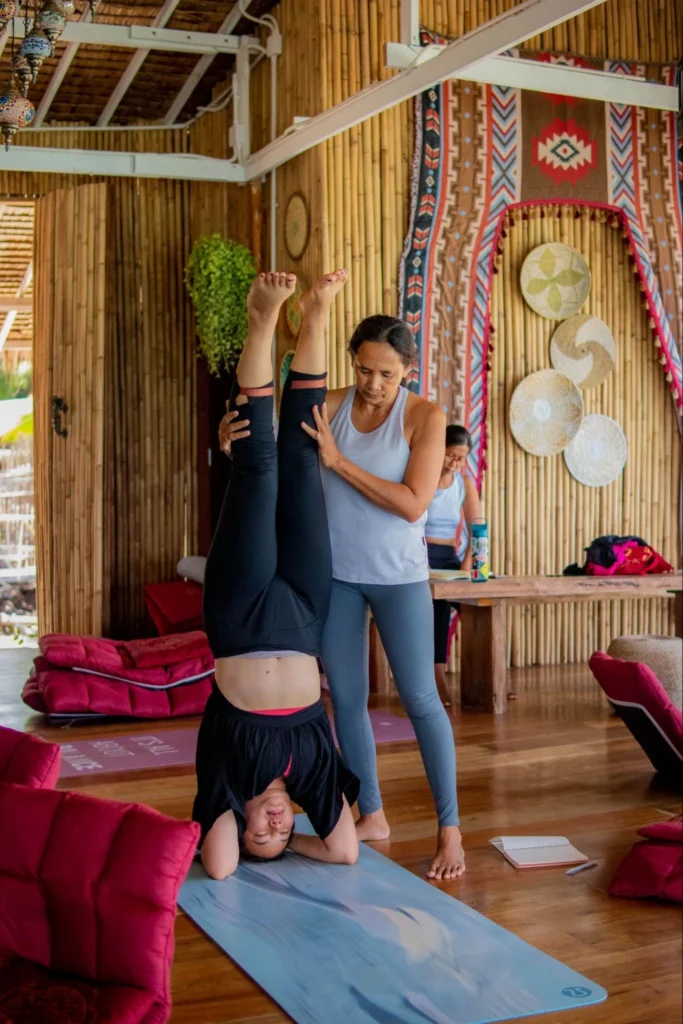
“Yoga instructor” and “yoga teacher” are used interchangeably across the industry. Neither title is a protected term, and neither establishes a government-issued qualification on its own. What matters is the training completed and the competence behind it.
A teacher training prepares you to do things a regular practice does not:
- Guide a room of people through a sequence rather than practicing alone
- Explain alignment clearly enough that someone who cannot see you still understands
- Modify postures for bodies that differ from your own
- Build a class with a logical structure
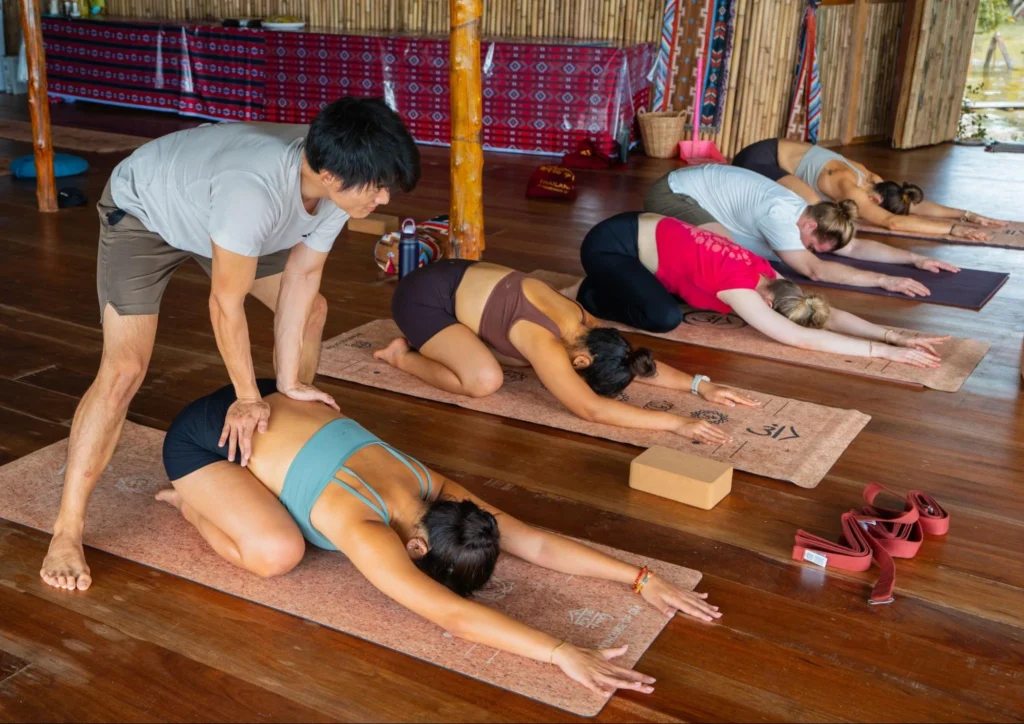
- Observe students and adjust in real time
- Understand enough anatomy to teach without causing harm
- Work within professional and ethical boundaries
That last group is what separates a training from an extended practice retreat, and it is worth checking for when comparing programs.
How Does Yoga Instructor Training Work?
The process is consistent across most schools, whatever the country or style.
Step 1: Choose a training program
You select a school, a format, and a set of dates. This is where most of the decision-making happens — curriculum depth, how much supervised teaching is included, who teaches, and whether the format fits the time you have.
Step 2: Complete the curriculum
You attend sessions, maintain a personal practice, study theory, complete assignments, and teach your peers. Programs vary in how they balance practice against classroom work, so read the syllabus rather than the summary.
Step 3: Complete teaching practice and assessments
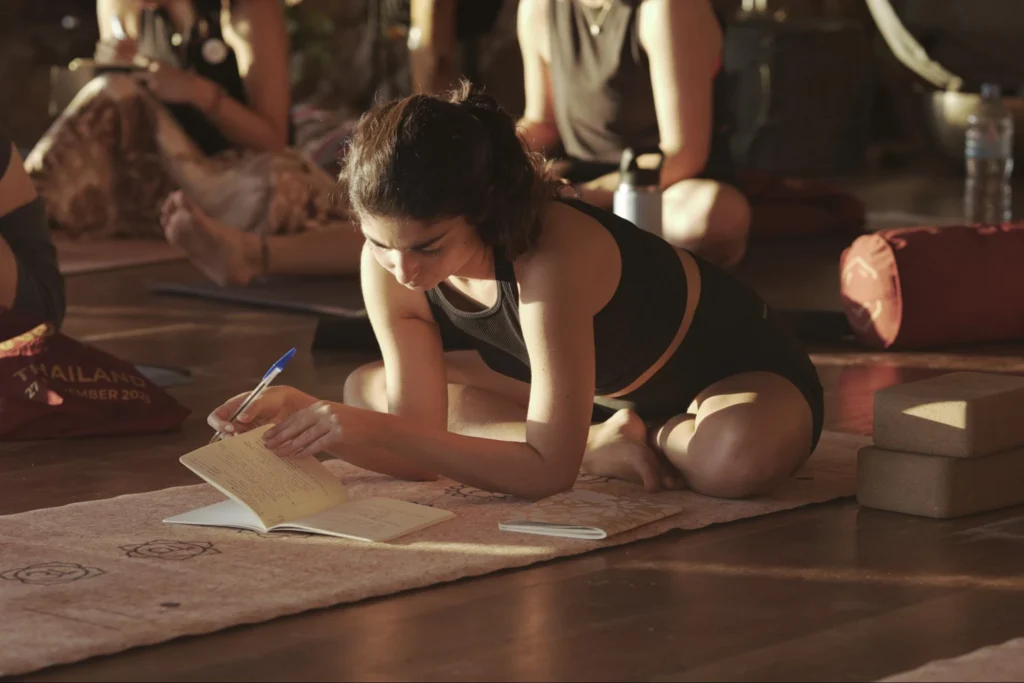
You teach, receive feedback, and are assessed. Assessment may include teaching a class, demonstrating alignment knowledge, designing a sequence, and written work. Attendance requirements usually apply.
Step 4: Receive the school’s completion certificate
The school issues a certificate confirming you completed its program. Ask what the certificate states before enrolling — course hours, dates, location, and the school’s registration status are all worth having on it.
Step 5: Apply for an external credential if you choose to
If the program qualifies, you can apply separately for individual registration with a body such as Yoga Alliance. This is your application to make, not something the school does for you, and it is optional in many contexts.
| Stage | What you get | Who issues it |
|---|---|---|
| Training | The education itself | The school |
| Assessment | Confirmation you met the requirements | The school |
| Certificate | Proof of course completion | The school |
| Registration | An individual professional credential | Yoga Alliance, on your application |
| Teaching experience | Competence and references | Built over time |
| Work authorization | Legal permission to work in a country | National authorities |
Reading that chain top to bottom is the single most useful thing a prospective student can do. Each stage produces something different, and skipping over the distinctions is where most confusion starts.
What Do You Learn in a 200-Hour Training?
Yoga Alliance’s published standards organize a 200-hour program across four educational categories rather than prescribing a style: Techniques, Training and Practice; Anatomy and Physiology; Yoga Humanities; and Professional Essentials.
In practice, that translates into the following areas.
Yoga techniques and practice
Daily asana practice, pranayama, and meditation, studied more precisely than in a general class. You learn how postures are constructed rather than only how to perform them.
Anatomy and physiology
Joint actions, range of motion, and individual variation. The purpose is not memorizing muscle names but understanding why one instruction cannot be correct for every body. A responsible program also teaches the difference between unfamiliar effort and pain that signals something is wrong.
Teaching methodology
Cueing, demonstration, voice, pacing, observation, and class management. This is the craft of teaching rather than the practice of yoga, and it is where a training earns its value.
Sequencing and class planning
How a class is built — how it opens, progresses, peaks, and closes. Without this, a new teacher has techniques but no structure to put them in.
Alignment and modifications
Learning to see when something is not working and to offer an alternative. Hands-on adjustment, where taught, requires being in a room with someone — it is the hardest component to learn remotely.
Yoga philosophy and ethics
The tradition behind the practice, plus the professional side: boundaries, consent around physical adjustments, inclusive teaching, and scope of practice.
Teaching practicum
Actually teaching, with feedback. Ask any school how many times you will teach, who observes, and how soon feedback comes. Vagueness here is the most meaningful warning sign in the whole comparison.
What Are RYS 200 and RYT 200?
| The short version
RYS 200 refers to the school. RYT 200 refers to the teacher. A school holds Registered Yoga School status; an individual holds Registered Yoga Teacher registration, applied for after graduating. |
| Credential | Applies to | How it is obtained | What it does not mean |
|---|---|---|---|
| RYS 200 | The school or program | The school meets the registry’s standards | It does not automatically register you |
| RYT 200 | The individual teacher | You apply after completing qualifying training | It is not a government license |
| RYT 500 | The individual teacher | Further qualifying training, plus teaching hours | Not required for entry-level teaching |
| E-RYT | The individual teacher | RYT plus documented teaching experience | A new graduate would not hold it |
You can verify any school’s current status in the Yoga Alliance school directory rather than relying on a logo. For the full credential picture — fees, employer expectations, and specialized qualifications — see our guide to yoga certification requirements in Thailand.
What Happens After You Complete Training?
- Complete all course requirements, including attendance and assessments.
- Receive the school’s completion certificate.
- Apply for individual registration if you are eligible and want the credential.
- Build teaching experience — cover classes, community sessions, small groups.
- Arrange professional liability insurance before teaching.
- Apply for teaching opportunities that match your actual training.
- Continue studying and, in time, consider specializing.
Graduation does not guarantee employment. What tends to matter alongside the certificate is teaching ability, reliability, communication, references, and how you perform in an audition class.
Can Beginners Join Yoga Instructor Training in Thailand?
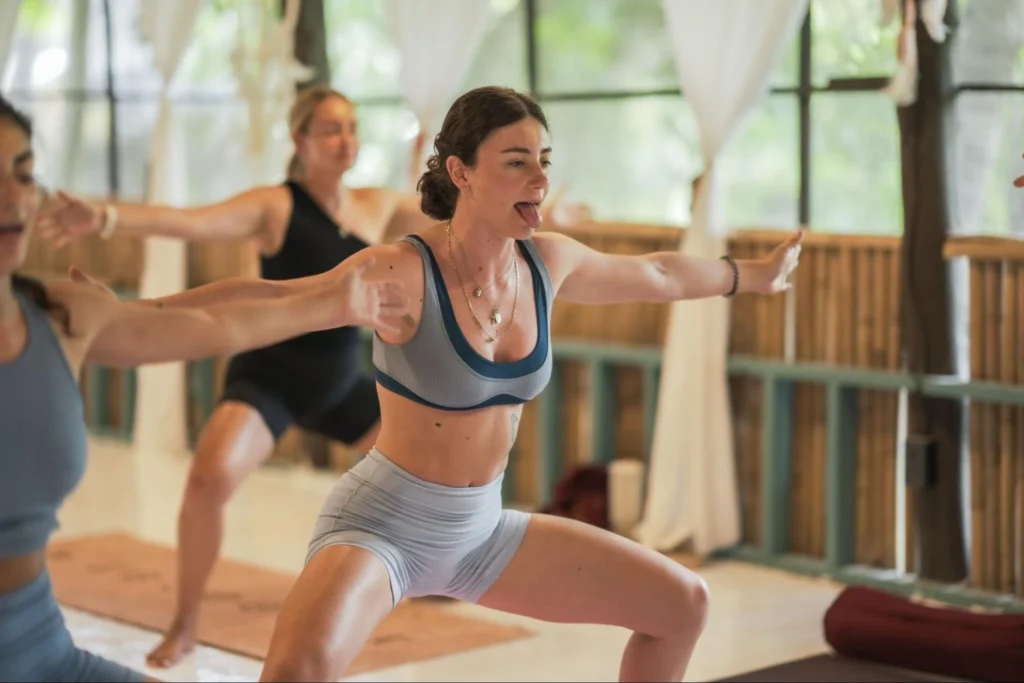
| Direct answer
It depends on the school’s entry requirements. Some programs accept complete beginners; others expect an established personal practice. Flexibility is not a prerequisite anywhere — you are learning to instruct safely and adapt for different bodies, not to perform advanced postures. |
As one example: House of Om states that its 200-hour yoga teacher training in Thailand welcomes all levels, beginners and beyond, and that teaching ambitions are not required to join. That is one school’s stated policy rather than a general rule.
If you are new, ask specifically: how are modifications taught, how are injuries handled, and how much individual attention is available during practicum. Those three answers tell you more than any entry requirement.
How Long Does Yoga Instructor Training Take?
It depends on the format. Residential programs are typically intensive and completed over a continuous period; hybrid programs spread theory over a longer window with a shorter in-person block; online programs vary widely.
Ask whether an advertised duration includes self-study, assignments, exam preparation, and arrival and departure days. A shorter course is not automatically better — the amount of supervised teaching and feedback matters more than the calendar length.
For House of Om specifically, the Thailand residential program runs 20 days and the hybrid includes a 10-day in-person component. Current dates should be checked on the program pages before booking travel.
Residential vs. Hybrid Training
| Feature | Residential | Hybrid |
|---|---|---|
| Learning format | Primarily in person | Online study plus in-person block |
| Schedule | Intensive and continuous | More flexible |
| Teacher access | Daily throughout | Concentrated in the immersion |
| Community | Strong, sustained | Concentrated, then remote |
| Practical teaching | Spread across the course | Within the in-person component |
| Best suited to | Those who can step away for a continuous period | Those needing flexibility |
| Main consideration | Time away from home and work | Self-directed study discipline |
The honest question for the hybrid format is whether you finish online courses you start. The in-person portion is structured for you; the theory is not.
What Does a Typical Day Look Like?
There is no universal Thailand YTT schedule. A residential program generally combines morning practice, pranayama, theory, anatomy, teaching methodology, alignment work, meals, self-study, and an evening session — but the specifics differ between schools. Ask for the full timetable before paying a deposit.
House of Om’s current Koh Phangan 200-hour schedule
| Time | Session |
|---|---|
| 06:00 – 06:15 | Shatkarma |
| 06:15 – 06:30 | Chanting |
| 06:30 – 07:45 | Asana and pranayama |
| 08:00 – 08:45 | Morning lab |
| 08:45 – 10:00 | Breakfast |
| 10:00 – 12:00 | Jnana yoga |
| 12:00 – 13:15 | Yoga Nidra |
| 13:15 – 14:30 | Lunch |
| 14:30 – 15:30 | Teaching methodology |
| 15:30 – 16:45 | Alignment and adjustment |
| 17:00 – 18:00 | Evening sadhana |
House of Om notes that the daily schedule is subject to change at the teacher’s discretion. This is one school’s published structure, not a Thailand-wide standard.
Which Yoga Styles Can You Study?
| Style | Emphasis | Suits students who |
|---|---|---|
| Hatha | Foundations, alignment, steady practice, breath awareness | Value precision and detail |
| Vinyasa | Breath-led movement, transitions, creative sequencing | Enjoy variety and class design |
| Ashtanga | Established sequences, repetition, progression | Prefer structure and discipline |
Many 200-hour programs are multi-style rather than dedicated to one tradition. House of Om’s Thailand programs use a multi-style curriculum incorporating Hatha, Vinyasa Flow, and elements of Ashtanga, structured across three weeks by style in the residential format.
For a beginner, multi-style exposure is arguably an advantage. If you have not taught yet, you probably do not know which style you want to teach, and experiencing all three gives you a basis for that decision.
Is Instructor Training the Same as Certification?
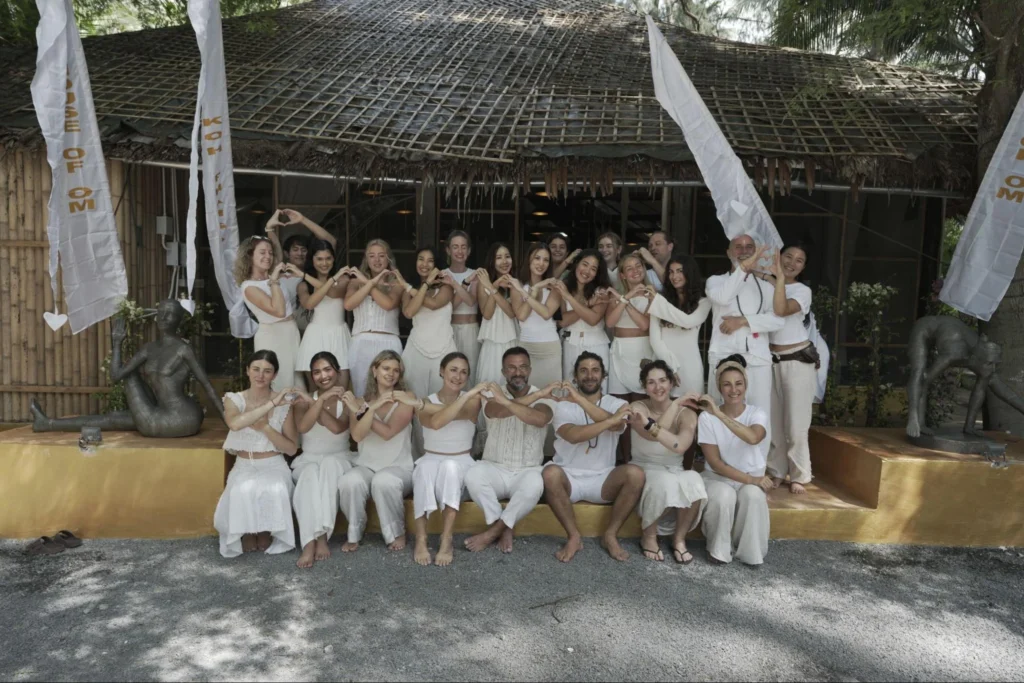
No. They are related stages in one process, and separating them prevents most of the misunderstandings in this field.
| Concept | What it actually is |
|---|---|
| Training | The education — what you study and practice |
| School certificate | Documentary proof you completed that education |
| Individual registration | A voluntary professional credential you apply for |
| Work authorization | Legal permission to work, granted by national authorities |
Can You Teach Yoga in Thailand After Training?
Completing a training in Thailand does not by itself authorize paid work there. Thailand’s Ministry of Foreign Affairs states that foreigners entering Thailand are not permitted to work, regardless of their type of visa, unless they are granted a work permit, and must hold the correct type of visa to be eligible to apply for one.
Training in Thailand and working in Thailand are different activities with different requirements. If your plan is to train there and then teach at home or online from elsewhere, this question largely does not arise. If you intend to stay and teach, research it before choosing a school rather than after.
| Important
Immigration, work-permit, tax, and employment rules can change and may depend on your nationality and work arrangement. If you plan to teach for payment in Thailand, confirm current requirements with Thai immigration, the relevant embassy or consulate, your employer, or a qualified local adviser. This article is general information, not legal advice. |
Do Yoga Instructors Need Insurance?
A school certificate does not provide insurance coverage. Many studios and retreat centers ask teachers to hold professional liability cover before they can teach, and some employers carry their own policy that may or may not extend to you.
Worth checking: whether a policy covers teaching abroad, online classes, private sessions, and physical adjustments. Some policies exclude specific modalities or countries, so read the terms rather than assuming.
Do You Need 300 or 500 Hours?
Not usually for entry-level general teaching. The 200-hour is the standard starting qualification; the 300-hour is advanced training taken afterward; together they form the 500-hour pathway.
Taking advanced training immediately after a foundational course tends to waste much of its value. Advanced study assumes you have taught, encountered real problems, and formed questions worth answering.
House of Om’s Yoga Instructor Training in Thailand
| Detail | Information |
|---|---|
| Program | 200-Hour Yoga Teacher Training |
| Location | Koh Phangan, Thailand |
| Format | In-person residential |
| Duration | 20 days |
| Curriculum type | Multi-style — rooted in Hatha and Vinyasa Flow, with elements of Ashtanga |
| Structure | Week 1 Hatha foundation, Week 2 Vinyasa flow, Week 3 Ashtanga and teaching mastery |
| Assessment | Practical and theoretical exams at the end of training |
| Entry level | All levels welcome, beginners and beyond |
| Accommodation | 19 nights at a beachfront resort |
| Meals | Fresh, Ayurvedic-inspired vegetarian meals with organic ingredients |
| Certification | Internationally recognized Yoga Alliance certification on successful completion |
The program includes daily practice, alignment workshops, hands-on adjustments, injury-prevention biomechanics, sunrise classes, afternoon labs, and mentor feedback, alongside shatkarma, mantra and meditation, Yoga Nidra, Ayurveda, kirtan, sound healing, and Voice Activation.
Current dates, pricing, and room options change by intake and should be checked on the program page before booking.
The hybrid alternative
The hybrid yoga teacher training in Thailand combines self-paced online study with a 10-day in-person immersion in Koh Phangan, including 9 nights of accommodation and two meals per day on training days. The online component includes 200+ hours of video lessons, 250+ lessons, 300+ quizzes, and 20 study modules. Students can start online or start in person, and both components must be completed before the certificate is issued.
| Feature | 200-Hour Residential | 200-Hour Hybrid |
|---|---|---|
| Location | Koh Phangan | Koh Phangan |
| Format | In person | Online plus in person |
| In-person period | 20 days | 10 days |
| Online component | No | Yes |
| Accommodation | 19 nights | 9 nights / 10 days |
| Meals | Fresh, Ayurvedic-inspired vegetarian | 2 meals per day on training days |
| Best for | Full immersion | Flexible learners |
These are separate programs with their own dates, pricing, and inclusions. Do not assume identical delivery from the shared hour count.
Who it may and may not suit
It may suit someone wanting a multi-style foundation, a residential setting in Koh Phangan, and teaching methodology alongside anatomy and philosophy. It is likely not the right fit for someone seeking a single-lineage specialist program, a purely online credential, a specialty qualification such as prenatal yoga, or a training that comes with a work arrangement attached.
How to Choose a Training
- Read the full curriculum, not the summary.
- Ask how many hours of supervised teaching practice are included.
- Find out who is teaching your specific dates.
- Verify the school’s registration status independently.
- Confirm assessment and attendance requirements.
- Ask for the group size cap in writing.
- Confirm accommodation type and number of nights.
- Confirm meals — how many per day, and on which days.
- Calculate the total cost, including what is excluded.
- Read the cancellation and rescheduling terms.
- Ask what support exists if you struggle or fall ill.
- Check recent independent reviews.
Warning Signs of a Weak Training
These are worth taking seriously. One is a question; several together is a reason to look elsewhere.
- Guaranteed employment or income after graduation
- Credential claims that do not resolve to a verifiable registry listing
- No named teachers before you book
- No detailed syllabus provided before payment
- Vague answers about supervised teaching hours
- No clear assessment or graduation requirements
- Certification described as automatic on attendance
- Therapeutic or medical claims without appropriate qualifications
- Unclear pricing, or fees that appear after the deposit
- No written cancellation or refund terms
- Pressure to pay quickly, or countdown timers on a deposit
The pattern worth noticing: weak programs are vague about the things that cost them money to provide — teacher time, small groups, individual feedback — and specific about the things that cost nothing, like the setting.
What Should You Prepare?
- A consistent personal practice in the weeks beforehand — regularity over intensity
- Familiarity with foundational postures and breath awareness
- Sleep and hydration, prioritized in the final week
- Any pre-course reading the school recommends
- Travel documents and insurance, arranged early
- Comfortable practice clothing, a water bottle, and a notebook
- Personal medication, and notice to the school of injuries or dietary needs
Avoid a sharp increase in training just before you travel. Arriving rested is more useful than arriving fit but depleted.
Career Options After Training
| Path | What it typically involves |
|---|---|
| Studio classes | Regular or cover classes, usually after an audition |
| Retreats | Guest teaching, often requiring experience and references |
| Hotels and resorts | Employer approval and appropriate work authorization |
| Private clients | Recognized training and professional liability insurance |
| Online classes | Training plus insurance and a reliable teaching setup |
| Corporate and community | Accessible teaching for mixed-ability groups |
| Further specialization | Additional training for specific populations |
Certification does not guarantee employment. What improves employability is teaching experience, clear communication, reliability, references, safety awareness, and being honest about the scope of what you have studied.
If travel is not possible, House of Om also offers an online 200-hour program. Hands-on adjustment is difficult to learn remotely, but it removes the travel constraint entirely.
Frequently Asked Questions
What is yoga instructor training in Thailand?
A structured teacher-training program covering yoga practice, anatomy, philosophy, teaching methodology, sequencing, breathwork, and supervised teaching. A 200-hour program is the common starting point for people preparing to teach general classes.
How long does yoga instructor training take in Thailand?
It depends on the format. Residential programs are typically intensive and continuous; hybrid programs spread theory over a longer period with a shorter in-person block. House of Om’s Thailand residential program runs 20 days, with a 10-day in-person component in its hybrid format.
Can beginners join yoga instructor training in Thailand?
It depends on the school’s entry requirements. Some accept complete beginners; others expect an established practice. House of Om states that its Thailand program welcomes all levels, beginners and beyond.
What certification do you receive after a 200-hour training?
The school issues a completion certificate once you meet its requirements. If the program qualifies, you may then apply separately for an individual credential such as RYT 200. The two are related but not the same thing.
What is the difference between RYS 200 and RYT 200?
RYS 200 refers to the school — a Registered Yoga School at the 200-hour level. RYT 200 refers to the individual teacher who completed qualifying training and registered themselves. A school cannot issue you an RYT credential.
Can I teach yoga after completing a 200-hour course?
It is the common entry-level qualification, but graduation does not guarantee employment. Studios set their own hiring criteria and often consider teaching experience, an audition, insurance, and references alongside the certificate.
Can foreigners teach yoga in Thailand?
Only with appropriate authorization. Thailand’s Ministry of Foreign Affairs states that foreigners are not permitted to work regardless of visa type unless granted a work permit, and must hold the correct visa to be eligible to apply.
Does RYT 200 allow me to work in Thailand?
No. RYT 200 is a voluntary professional credential from a membership organization. It is not issued by any government and does not determine whether a foreign national may legally work in Thailand.
Is hybrid yoga instructor training valid?
It depends on the school, the credentialing body, and the employer. Ask how the hours are divided between online and in-person delivery and confirm the split matches the credential you want before enrolling.
How much does yoga instructor training in Thailand cost?
There is no single Thailand-wide price. Costs depend on school, location, duration, accommodation, meals, and format. Compare itemized inclusions rather than headline figures, and check the current program page for live pricing.
Does House of Om offer yoga instructor training in Thailand?
Yes. House of Om offers a 200-hour Yoga Teacher Training in Koh Phangan and a 200-hour hybrid option combining online study with a 10-day in-person immersion.
What styles are included in House of Om’s Thailand training?
The programs use a multi-style curriculum rooted in Hatha and Vinyasa Flow, with elements of Ashtanga. The residential program is structured across three weeks by style, closing with practical and theoretical exams.
Final Recommendation
Yoga instructor training follows a consistent path: complete a qualifying program, pass the assessments, receive the school’s certificate, optionally register for an individual credential, then build teaching experience. Supervised teaching practice is the part that determines whether you can actually lead a class afterward, so weight it heavily when comparing schools.
Choose residential if you want immersion and can step away for a continuous period. Choose hybrid if you need flexibility and can manage self-directed study. And verify current program details before booking — dates, pricing, and inclusions change.
If you want a multi-style foundation in Koh Phangan, review House of Om’s 200-hour yoga teacher training in Thailand and its hybrid option, or compare all current programs. You can also read House of Om student experiences before deciding.