
Preparing for a yoga teacher training is not mainly about yoga. Most of what determines how the first week goes is logistical and practical: whether your documents are in order, whether you packed for the actual climate, whether you arrived rested, and whether you have a realistic idea of what the days involve.
| The short version
Understand what the training demands, sort your travel documents and arrival buffer, pack light and climate-appropriate, build a consistent practice in the weeks beforehand, and arrive ready to learn rather than trying to become an expert first. Nobody expects you to arrive good at yoga. They expect you to arrive able to participate. |
This guide is a pre-arrival checklist. It covers preparation in six areas: physical, mental, academic, packing, travel, and practical.
What to Prepare, at a Glance
| Area | What to do before you arrive |
|---|---|
| Course information | Read the full program details. Confirm dates, what is included, and what is not. |
| Physical | Build a consistent practice. Aim for regularity rather than intensity. |
| Mental | Set realistic expectations for an intensive schedule and for being a beginner again. |
| Study | Get familiar with common Sanskrit terms and basic anatomy. Familiarity, not mastery. |
| Packing | Light, breathable, quick-drying. Fewer items than you think. |
| Travel | Passport validity, entry requirements, arrival card, flights, ferry connection, insurance. |
| Accommodation | Confirm what your booking includes and raise any requirements early. |
| Food | Declare allergies and dietary needs at the enquiry stage, not on arrival. |
Do You Need Previous Yoga Experience?
This varies by school, so check the specific program rather than assuming. Some trainings expect an established practice; others are explicitly open to beginners.
House of Om states that its Thailand training welcomes all levels, including complete beginners, and that students do not need teaching ambitions to enroll — some join purely to deepen a personal practice. If you are looking at the 200-hour training in Koh Phangan, that is the stated policy. Other schools differ, so always confirm.
Being eligible and being ready are slightly different things, though. There is no minimum requirement here, but a few months of regular practice buys you bandwidth. Training moves quickly, and if you are still working out what an instruction means in your own body, you will spend the anatomy sessions translating rather than absorbing.
How to Prepare Physically
Consistency matters far more than capability. You are not being assessed on how deep your forward fold is.
Build a regular practice
- Practice several times a week rather than occasionally and hard
- Spend time on foundational postures rather than chasing advanced ones
- Get used to following spoken instruction without watching a screen
- Include some breathwork, even a few minutes
- Practice sitting still, which is harder than most people expect and comes up constantly
Get used to longer sessions
An intensive training involves several sessions across a day, spread between morning practice, classroom study, and teaching work. If your usual practice is a single class a week, the volume is the adjustment, not the difficulty of any individual posture.
In the six to eight weeks before you travel, gradually extend your practice length. Going from one hour to ninety minutes occasionally is more useful preparation than adding difficult postures.
Arrive rested
This is the most underrated item on the list. Days start early, and the first week is when you are also adjusting to a new place, a new group, and a new routine. Arriving already depleted from a busy period at work makes the first few days considerably harder than they need to be.
How to Prepare Mentally
A teacher training is a course, not a retreat. Expect study, assessment, and being observed while you teach.
Be ready to be a beginner again
You will be corrected, you will teach badly before you teach well, and you will be asked to do things in front of other people that you have not done before. People who find this hardest are usually those who are competent in their working lives and unused to being visibly new at something.
Expect the middle to be harder than the start
The first days carry novelty. The end carries the finish line. The middle stretch is where the early mornings accumulate and the practicum starts to feel real. That pattern is common enough to plan for, and knowing about it in advance takes most of the sting out of it.
What Should You Study Beforehand?
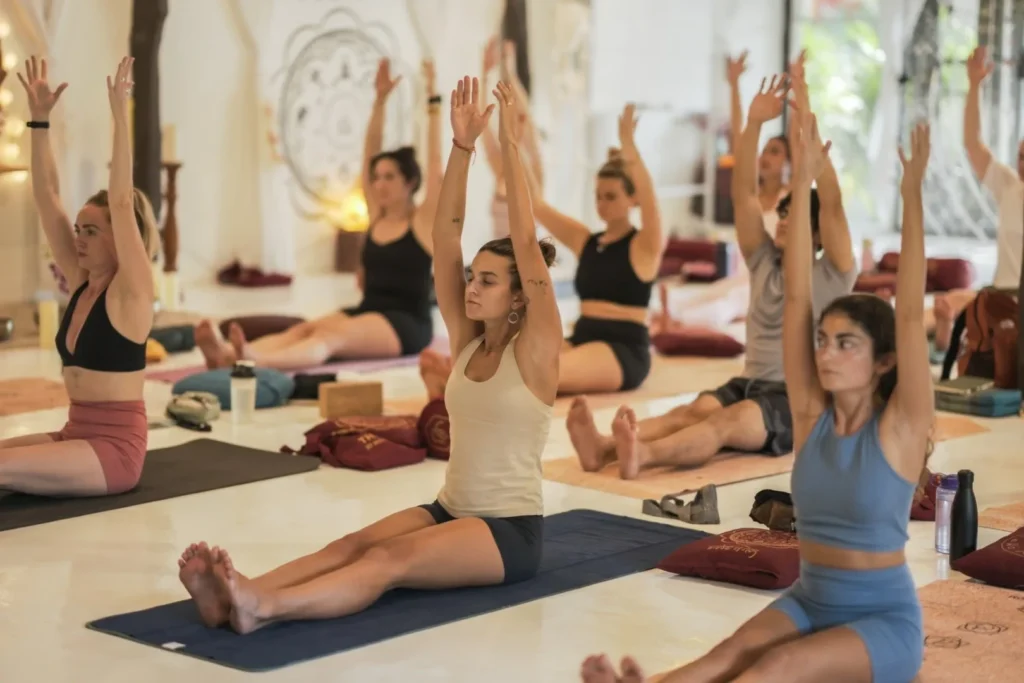
Aim for familiarity, not mastery. The point is to recognise terms when you hear them, so your attention goes to the content rather than the vocabulary.
| Topic | What is useful before you arrive |
|---|---|
| Sanskrit terms | Recognise the names of common postures and a handful of core concepts. Do not attempt fluency. |
| Basic anatomy | Major muscle groups, the main joints, and how the spine moves. Not professional-level knowledge. |
| Breathwork | Know what pranayama refers to and try a simple technique. |
| Philosophy | Read a translation of the Yoga Sutras once, without trying to memorise anything. |
| Class structure | Notice how your own teacher sequences a class. Free, and genuinely useful. |
That last one is the highest-return preparation on the list and almost nobody does it. For a month before you travel, attend classes as an observer as well as a participant. Watch how the teacher opens, how they build to a peak, how they handle someone struggling, what they say when the room is tired. You will start the teaching methodology module with a set of real examples in your head instead of an empty page.
Do you need to learn Sanskrit first?
No. Basic familiarity helps, fluency is unnecessary, and every training teaches the terminology it uses. Recognising a dozen posture names is plenty.
What to Pack for a Yoga Teacher Training in Thailand

The climate does most of the work here. It is warm and humid year-round, so pack light, breathable, and quick-drying.
Practice clothing
- Two to three sets of practice clothes — laundry is easier than luggage
- Breathable, quick-drying fabrics; heavy cotton stays damp in humidity
- One layer for early mornings and air-conditioned rooms
- Modest clothing that covers shoulders and knees for temple visits
Study items
- A notebook and pens. You will write more than you expect
- Highlighters if that is how you study
- A device only if you genuinely need one — many students prefer to be off screens
Personal items
- Reef-safe sunscreen and insect repellent
- A reusable water bottle
- Any personal medication, in sufficient quantity, in original packaging
- Basic first-aid items
- Quick-drying towel
Documents
- Passport, with a photo of it stored separately
- Booking confirmations for the course, flights, and ferry
- Travel insurance documents
- Emergency contacts, written down rather than only on your phone
| Before you buy anything
House of Om provides a welcome bag containing training materials, a neti pot, a mala bead, and a sarong. Check what your specific program supplies before shopping — including whether mats are provided — so you are not carrying duplicates halfway around the world. |
What not to overpack
- Shoes. Sandals cover almost every situation
- Full-size toiletries. Most things are available locally and cheaply
- Smart or formal clothing. There is no occasion for it
- Multiple electronic devices
- A month of outfits. You will live in practice clothes
How to Prepare for Travel to Thailand
Two items here are non-negotiable, and one of them catches people out regularly.
The arrival card most people do not know about

Thailand replaced its paper TM6 arrival card with the Thailand Digital Arrival Card (TDAC) in May 2025. It is mandatory for foreign nationals arriving by air, land, or sea; it must be completed online before you travel, and it applies to every entry — including a re-entry after a trip to a neighboring country.
| Two things to know about the TDAC
It is free. The official portal is tdac.immigration.go.th, and its own page title states that no fees are required — which tells you how common the paid lookalike sites have become. Never pay for it. Second, it is single-entry: if you leave Thailand and come back, you file a new one. |
Passport and entry permission
Your passport generally needs at least six months of validity remaining. Check yours now rather than a fortnight before you fly, since renewals take time.
Visa exemption rules for Thailand are currently in flux. The standard visa-free period was extended to 60 days for many nationalities in 2024, and a reduction back to 30 days has since been approved, with reporting varying on exactly when it takes effect and which nationalities are affected. This article deliberately does not state a number, because any figure quoted here could be wrong by the time you read it.
Check your own nationality’s current entitlement with an official Thai government source or your nearest Thai embassy before booking flights. This matters more than usual if you are planning to travel before or after your course, because the permitted stay may be shorter than it was.
Getting to the island
Koh Phangan has no airport, so arrival involves a ferry. Most people fly to Koh Samui, Surat Thani, or Nakhon Si Thammarat and continue by boat, usually arriving at Thong Sala.
- Allow most of a day for the final leg
- Do not book a flight landing late on the day your course starts — standard ferries run in daylight hours
- Arrive at least a day early. It costs one night and removes the single biggest thing that can go wrong
- Build a buffer on departure too
What the Daily Schedule Involves
Knowing the shape of a training day is the difference between adjusting in two days and adjusting in a week.
House of Om’s Thailand schedule begins at six in the morning with cleansing practices and chanting, moves into asana and pranayama, then breaks for breakfast. The middle of the day covers classroom study, with teaching methodology and alignment work in the afternoon and a closing evening session. Days run roughly from six until early evening.
The practical implications for preparation:
- Shift your sleep schedule earlier in the week before you travel, not on arrival
- Expect around eight hours of structured activity daily, plus practicum preparation
- Free time exists but is limited, so plan sightseeing for before or after the course
- Rest days are for resting. Filling them with excursions is the most common route to burning out mid-course
Accommodation and Food
House of Om’s Thailand program includes accommodation at a beachfront resort in Koh Phangan, with a choice of room types from shared to private, and a training-only option if you prefer to arrange your own stay. Meals are fresh vegetarian, Ayurvedic-inspired, and prepared with organic ingredients.
Two things worth sorting before you travel:
- Dietary requirements. Raise allergies and restrictions at the enquiry stage rather than on arrival. Kitchens catering for a group need notice, and a serious allergy is not something to mention at the first meal.
- Room choice. This is a recovery decision, not a budget one. Shared rooms build the group quickly; private rooms give you somewhere to decompress when the middle of the course gets demanding. If you know you need solitude to process things, factor it in early.
For anything not covered on the program — laundry, transfers, what is available locally — ask before you travel. [VERIFY WITH HOUSE OF OM: laundry facilities and airport or pier transfer arrangements, neither of which is specified on the current program]
Common Mistakes Before Arrival
- Booking flights before confirming a place on the course
- Arriving on the day the course starts, with no buffer for the ferry
- Not filing the TDAC, or paying a lookalike site for it
- Assuming the visa-free period is what it was last year
- Overpacking, then carrying it across two transfers
- Arriving exhausted from clearing the decks at work
- Trying to learn the whole curriculum in advance instead of practicing consistently
- Believing you need to be flexible or advanced to belong there
- Mentioning a dietary requirement for the first time at the first meal
- Planning to work remotely during the course
- Booking excursions on every rest day
- Leaving passport renewal until the last month
One Month Before
❑ Confirm course dates and that your place is secured
❑ Check passport validity — renew now if it is close
❑ Check current entry requirements for your nationality with an official source
❑ Book flights around the confirmed course dates
❑ Arrange the ferry connection and any extra nights either side
❑ Take out travel insurance covering course fees, not only medical costs
❑ Confirm dietary requirements with the school in writing
❑ Start extending your practice sessions
❑ Begin shifting your sleep schedule earlier
One Week Before
❑ File the TDAC — it is submitted shortly before arrival, so check the current timing window on the official portal
❑ Download and save all booking confirmations offline
❑ Photograph your passport and store it somewhere separate
❑ Check the forecast and adjust packing
❑ Tell your bank you are travelling; arrange a payment method that works locally
❑ Pack — then remove a third of it
❑ Confirm what the school provides so you are not duplicating
❑ Wind down work commitments properly
❑ Prioritize sleep this week specifically
The Day Before Training Starts
❑ Know exactly where to be and at what time
❑ Lay out practice clothes for the morning
❑ Charge everything and fill your water bottle
❑ Set two alarms
❑ Eat normally — this is not the moment to change your diet
❑ Get a full night’s sleep
What You Do Not Need to Worry About
Worth saying plainly, because these anxieties stop people booking:
- You do not need to touch your toes. Flexibility is not a prerequisite and is not assessed
- You do not need to know Sanskrit
- You do not need to have decided whether you want to teach
- You do not need to be the fittest person in the room, and you will not be the least experienced either
- You do not need to arrive having read everything. Turning up rested and willing counts for more
Trainees with limited range of motion often make better beginner teachers, because they have had to solve problems that naturally flexible practitioners never encounter.
Checking the Details With Your School
Whichever school you choose, get these confirmed in writing before you travel:
- What the accommodation includes, and what it excludes
- Which meals are provided and on which days
- What equipment and materials are supplied
- The policy if illness causes you to miss sessions
- Group size for your intake
- Who is teaching your specific dates
For House of Om specifically, the Koh Phangan program page lists inclusions and room options, teachers are named on the school’s teaching team page, and student support is contactable before arrival. If the full residential format does not fit your schedule, the shorter hybrid option has a different preparation profile — more self-directed study beforehand, less time away.
Frequently Asked Questions
How should I prepare for a yoga teacher training in Thailand?
Build a consistent practice in the weeks beforehand, sort your travel documents including the mandatory digital arrival card, pack light and quick-drying, shift your sleep schedule earlier, and arrive at least a day before the course starts.
Do I need previous yoga experience?
It depends on the school. House of Om states that all levels are welcome on its Thailand training, including complete beginners. Other schools set their own requirements, so check the specific program.
How fit do I need to be?
Fitness matters less than consistency. You are learning to teach safely and adapt for different bodies, not to perform advanced postures. Regular practice in the weeks before you travel is more useful than intensive training.
What should I pack?
Two or three sets of quick-drying practice clothes, a notebook, reef-safe sunscreen, insect repellent, a water bottle, any personal medication, and modest clothing for temple visits. Check what your school supplies before buying anything.
Should I study before the course?
Some familiarity helps, but mastery is unnecessary. Recognising common Sanskrit posture names and basic anatomy terms means your attention goes to the content rather than the vocabulary.
What does a typical training day involve?
On House of Om’s Thailand course, days begin at six with cleansing practices and chanting, followed by asana and pranayama, classroom study through the middle of the day, and teaching methodology and alignment work in the afternoon.
How early should I arrive in Thailand?
At least a day before the course starts. Koh Phangan has no airport, so arrival involves a ferry, and standard services run in daylight hours. A day of buffer removes the main thing that can go wrong.
Do I need to complete anything online before flying to Thailand?
Yes. The Thailand Digital Arrival Card replaced the paper arrival form in May 2025 and is required for every entry. It is free through the official government portal, and it must be filed before you arrive.
Is a 200-hour training physically demanding?
It is demanding in volume rather than difficulty. Several sessions a day across three weeks is more than most people are used to, but modifications are standard and the schedule is built around the climate.
What should I check before booking?
Course dates and availability, what the price includes and excludes, group size, the illness and missed-session policy, dietary arrangements, and current entry requirements for your nationality.
Arriving Ready
Preparation for a teacher training is mostly unglamorous: documents, sleep, and a bag that is lighter than you first packed. The yoga part looks after itself once you are there, which is rather the point of going.
If you are still choosing dates, current Koh Phangan availability is the place to start.