
Most people choosing a yoga teacher training compare schools, destinations, and prices. Fewer compare formats, even though format shapes the experience more than any of those. It determines how much time you spend with a teacher in the room, how much you travel, how much discipline the course demands of you, and in one important respect, what your certificate is worth.
There is no format that is best for everyone. There is a format that fits your circumstances, and this article is built to help you identify it.
The Three Formats at a Glance
| Online | In-person | Hybrid | |
|---|---|---|---|
| Where you learn | Anywhere | On site | Both |
| Flexibility | Highest | Lowest | Moderate |
| Face-to-face contact | None or live video | Continuous | During the immersion |
| Hands-on adjustment work | Not possible | Throughout | During the immersion |
| Travel | None | Full duration | Shorter trip |
| Self-discipline needed | High | Low | Moderate to high |
| Best for | Travel is impossible; strong independent learner | Wants full immersion and continuous teacher access | Limited leave, but wants hands-on practice |
What Is Online Yoga Teacher Training?

Online yoga teacher training delivers the course remotely. Most programs combine recorded video lessons, written material, and quizzes with some form of live session, and assess teaching through recorded submissions or video calls.
The quality varies enormously between providers, far more than in the other two formats. A program with a personal mentor, scheduled live sessions, and real feedback on your recorded teaching is a different product from a video library with a certificate at the end. The word “online” covers both.
Advantages of online yoga teacher training
- You can study around work, childcare, or anything else that cannot pause for a month
- No flights, no accommodation, no time off
- You can rewatch a difficult anatomy lesson as many times as you need
- It removes geography as a constraint on which school you choose
- Most programs let you set your own pace
Limitations of online yoga teacher training
- Hands-on adjustment cannot be taught through a screen — you can learn the theory, not the touch
- Nobody notices when you fall behind, so completion depends entirely on you
- The peer group is looser, and many people find the isolation harder than expected
- Feedback on your teaching is delayed rather than immediate
- There are real limits on how much of a 200-hour can be delivered online — covered in detail below
What Is In-Person Yoga Teacher Training?
In-person training happens entirely on site, usually residentially. You live with your cohort for the duration, practice together daily, and learn in a room with a teacher present throughout.
Most residential courses run three to four weeks as a full-time intensive. Some studios deliver the same hours across weekends spread over several months, which is technically in-person but a very different experience.
Advantages of in-person yoga teacher training
- Immediate correction — a teacher sees your alignment as it happens, not a week later on video
- Hands-on adjustment taught by being adjusted and adjusting others
- Repeated teaching practice in front of real people, with feedback the same day
- External structure, so completion does not depend on your willpower
- A cohort you go through something demanding with, which many graduates keep afterwards
- Genuine separation from ordinary life for the duration
Limitations of in-person yoga teacher training
- Three to four weeks away is impossible for many people
- Flights, accommodation, and food add substantially to the total, even when tuition is inclusive
- Fixed dates, so you fit the school’s calendar rather than your own
- The pace suits the group, not you — if you need longer on anatomy, the schedule moves anyway
- Unpaid leave is a real cost that rarely appears in any comparison
What Is Hybrid Yoga Teacher Training?
Hybrid splits the course: theory studied online at your own pace, and a shorter in-person block for practice, teaching, and assessment. The reasoning is that philosophy and anatomy survive a screen while hands-on work does not. Our guide to hybrid yoga teacher training in Thailand covers the format in depth, including how the two components fit together.
Advantages of hybrid yoga teacher training
- Around ten days away instead of a month, which fits standard annual leave
- You can arrive having already covered the theory, so the in-person days are spent applying it
- Real hands-on teaching practice, which fully online cannot provide
- Lower total trip cost than a full residential course
- Some schools let you choose which component to do first
Limitations of hybrid yoga teacher training
- The online portion still needs self-discipline, and this is where hybrid students most often stall
- Less total teacher contact than a full residential course
- A shorter cohort experience
- You still travel — hybrid shortens the trip rather than removing it
- Managing two learning environments suits some people and unsettles others
What Yoga Alliance Actually Allows — and Why It Matters
This is the section most format comparisons skip, and it is the one with real consequences.
Yoga Alliance’s published RYS hours policy states that under the standards for the RYS 200 credential introduced on 27 February 2020, all 200 hours must be classroom hours, with an option for 40 of those 200 to be delivered as online classroom hours — up to 20 in Anatomy and Physiology, and up to 20 in Yoga Humanities.
The same policy states that homework, reading assignments, personal practice, volunteer work, and public classes do not count as instructional hours, wherever they happen. It also caps instructional time at 14 hours per day.
| What this means in practice
A program advertised as “fully online” is not automatically a problem, but it is a question. Ask any school — whatever its format — how its 200 hours are allocated, how many are delivered online, and how that allocation satisfies the credential you want. Yoga Alliance also lists the policy’s last update date on its own page, and standards change, so verify directly with Yoga Alliance for your specific program and intake rather than relying on any school’s summary, including this one. |
You can check any school’s current registration in the Yoga Alliance school directory. That takes about two minutes and is worth more than any amount of website copy.
None of this makes online training illegitimate. It makes the question worth asking before you pay, which is a different thing.
The Detailed Comparison
| Factor | Online | In-person | Hybrid |
|---|---|---|---|
| Flexibility | Highest — study anywhere, usually any time | Lowest — fixed dates and daily schedule | High for theory, fixed for the immersion |
| Face-to-face learning | None, or live video only | Continuous for the full duration | Concentrated into the in-person block |
| Hands-on adjustment | Theory only | Practised repeatedly on real bodies | Practised during the immersion |
| Teaching practice | Usually recorded and reviewed later | In person, repeated, same-day feedback | In person, condensed into fewer days |
| Teacher feedback | Delayed; depends heavily on the program | Immediate and continuous | Immediate during the immersion |
| Peer interaction | Forums, groups, occasional live calls | Constant — you live alongside your cohort | Strong but brief |
| Travel | None | Full duration | Shorter trip |
| Time away from work | None required | Three to four weeks typically | Around ten days typically |
| Self-discipline | Essential | Largely provided by the structure | Needed for the online half |
| Separation from daily life | None — you study inside your normal routine | Complete | Partial |
| Best suited to | People who cannot travel and finish what they start alone | People who can take the time and want full immersion | People with limited leave who still want hands-on practice |
Which Format Suits Beginners?
All three can work for a beginner. The deciding factor is not experience level but how much structure you need.
A complete beginner learning entirely from video has nobody to notice that they are compressing their lower back in a backbend. That is the strongest argument for in-person or hybrid training early on — not that online teaching is worse, but that a beginner has fewer internal reference points to correct against.
If you have practiced for a while and know your own body reasonably well, online becomes a more reasonable option. If you are starting from very little, having someone in the room is worth paying for.
Which Format Works If You Work Full-Time?
| Your situation | Realistic option |
|---|---|
| No leave available at all | Online, or an in-person course delivered across weekends |
| Around two weeks of leave | Hybrid |
| A month available, or between jobs | Any of the three; in-person delivers the most per week |
| Unpredictable schedule | Online, for the ability to pause and resume |
One honest note about combining online study with a full-time job: it works, but it takes longer than people plan for. Two hundred hours is roughly five full working weeks of study. Spread across evenings, that is several months of consistent effort with nobody chasing you.
Which Format Gives the Most Teaching Practice?
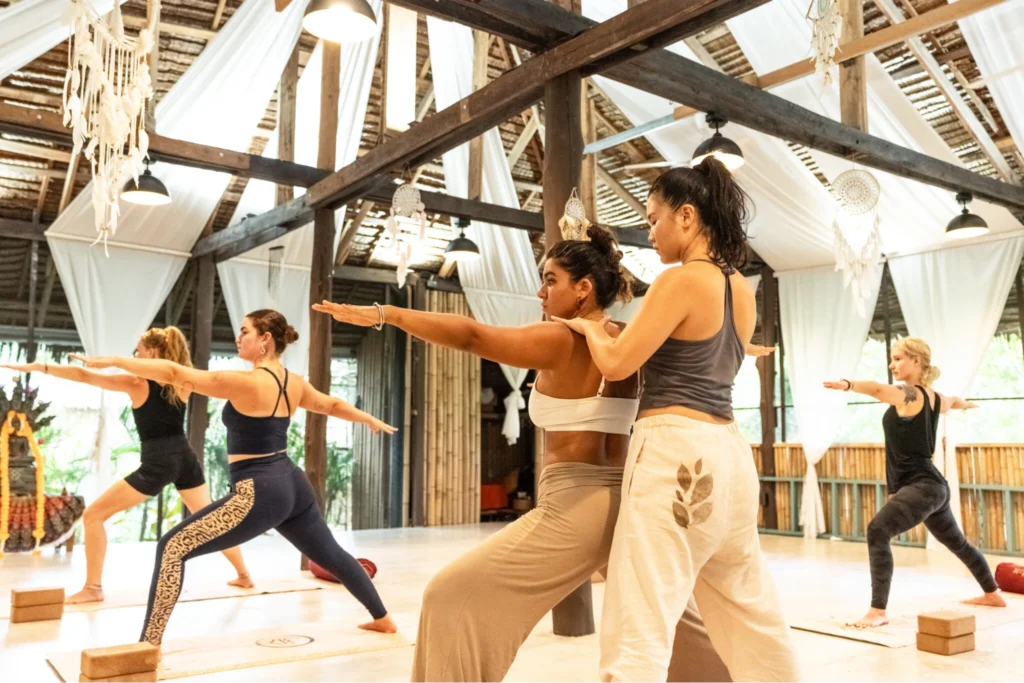
In-person usually gives the most, but the format name is not the answer. Program design is.
A well-built hybrid course with several days of dedicated practicum can deliver more supervised teaching than a residential course that fills its three weeks with asana and leaves practicum to the final two days. Ask for the number of practicum hours rather than assuming from the format.
What to ask any school:
- How many hours of supervised teaching practice are included?
- How many times will I teach a full class before graduating?
- Who gives the feedback, and how quickly?
- Am I assessed on a recorded video or in a room?
- How much hands-on adjustment practice is there, and is it in person?
What Each Format Really Costs
Tuition is the number people compare, and it is the one that misleads. Yoga Alliance notes that tuition is set by each school and commonly ranges from $1,500 to $5,000 or more, depending on length, location, and format — so format alone tells you very little about price.
Budget by category instead:
| Cost category | Online | In-person | Hybrid |
|---|---|---|---|
| Tuition | Yes | Yes | Yes |
| Flights | No | Yes | Yes |
| Accommodation | No | Full duration | Immersion only |
| Meals | Normal spending | Often partly included | Often partly included |
| Local transport | No | Yes | Yes |
| Time off work | Usually none | Three to four weeks | Around ten days |
| Insurance and visas | No | Yes | Yes |
One cost applies to every format and is almost always forgotten: Yoga Alliance registration. Its published fees are a one-time $50 application fee and a $65 annual membership. You pay this to Yoga Alliance after graduating, not to your school, and the annual fee continues for as long as you want the credential.
Online is usually cheapest overall and in-person usually dearest, but that is a tendency rather than a rule. A premium online program can cost more than a modest residential one.
How to Choose: A Decision Framework
| If this is true of you | Start by looking at |
|---|---|
| I cannot travel, and I reliably finish courses I start alone | Online |
| I have two weeks and want real hands-on teaching practice | Hybrid |
| I can take a month off and want to be fully immersed | In-person |
| I need deadlines and other people to finish anything | In-person |
| I am a complete beginner with little body awareness yet | In-person or hybrid |
| Cost is the binding constraint | Online |
| I want to teach professionally as soon as possible | Whichever offers the most supervised practicum hours |
Then apply the more important filter. A well-run online program with real mentoring beats a poorly run residential one, and the reverse is equally true. Format narrows the field; program quality decides the outcome.
Five Questions to Ask Before You Book
- How many hours of supervised teaching practice are included, and how many are in person?
- How is my teaching assessed, and how quickly do I receive feedback?
- Exactly which parts are online and which are in person, and how are the 200 hours allocated?
- Is the school currently registered with Yoga Alliance — verified in the directory, not on its own website?
- What is excluded from the price: meals, transfers, laundry, registration fees, materials?
Where House of Om Fits
House of Om runs programs in all three formats, which makes it a reasonable reference point for comparison.
- In-person: residential 200-hour trainings including the Koh Phangan course in Thailand, alongside sites in Bali and Rishikesh.
- Hybrid: online theory plus a shorter in-person immersion, offered in Thailand and Bali.
- Online: a self-paced 200-hour program with lifetime access to the materials.
The same questions in this article apply here as to any school: ask about practicum hours, hour allocation, and what is excluded from the price. You can see all programs and formats or compare training locations if destination is also part of your decision.
Frequently Asked Questions
Is online yoga teacher training as good as in-person?
It depends on the program and on you. Online cannot teach hands-on adjustment, and feedback is delayed rather than immediate. It can be excellent for theory and for people who study reliably alone. Check practicum hours and how teaching is assessed rather than judging by format.
Is hybrid yoga teacher training worth it?
It is worth it if you want in-person teaching practice but cannot take a month off. You get hands-on work and real feedback in a shorter trip. The trade-off is that the online portion depends entirely on your own discipline.
Which format is best for beginners?
No format is best universally, but a complete beginner benefits most from having a teacher in the room, because they have fewer reference points for correcting their own alignment. In-person or hybrid usually suits early-stage practitioners better.
Can I become a yoga instructor through online training?
Many people do. Check how the program’s 200 hours are allocated between online and in-person delivery, and confirm with Yoga Alliance that the allocation meets current standards for the credential you want.
Does online yoga teacher training include practical teaching?
Most programs include some, usually through recorded teaching submissions reviewed by a mentor. What varies is how much and how detailed the feedback is. Ask for specifics before enrolling.
Do hybrid programs require travel?
Yes. Hybrid shortens the trip rather than removing it. The in-person immersion still requires you to be there, typically for around ten days.
Which format is most flexible?
Online, by a clear margin. You choose where and usually when you study. Hybrid is flexible for the theory portion but fixed for the immersion dates. In-person is the least flexible of the three.
How do I choose a 200-hour yoga teacher training format?
Start with your constraints: how much time you can take off, whether you can travel, and how well you study without external structure. That narrows it to one or two formats. Then compare program quality, which matters more than format.
What should I check before choosing any program?
Supervised practicum hours, how the 200 hours are allocated between online and in-person delivery, current Yoga Alliance registration verified in the directory, who is teaching your intake, and what is excluded from the quoted price.
Does the format affect my certificate?
The credential itself does not change with format. What can differ is whether a given program’s hour allocation meets the standards for that credential, which is why the allocation question is worth asking of every school.