
Hybrid yoga teacher training splits a 200-hour course into two parts: theory studied online at your own pace, and a shorter block of in-person training where you practise, teach, and get assessed. You still travel. You just travel for less time.
That trade appeals to people who cannot take a month off but want real face-to-face teaching practice. It does not suit everyone. This article explains how the format works, what the in-person portion covers, and how to judge whether it fits your circumstances better than a fully residential or fully online course.
What Is Hybrid Yoga Teacher Training?
| In brief
Hybrid yoga teacher training delivers the theoretical parts of a 200-hour course online — philosophy, anatomy, meditation theory, teaching methodology — and the physical and practical parts in person. Students complete both components to qualify for certification. |
The logic behind the split is straightforward. Reading about the Yoga Sutras or the shoulder girdle works perfectly well from your sofa, and you can revisit a recorded lesson as many times as you need. Learning to adjust someone’s posture with your hands, or to hold a room while you teach, does not translate to video.
So a hybrid program puts the material that survives a screen online, and reserves the in-person time for the parts that need a teacher standing next to you.
How Does Hybrid Yoga Teacher Training in Thailand Work?
Formats vary between schools, so this section describes how House of Om’s hybrid program in Koh Phangan is structured, as a concrete example. Its two components are a self-paced online module and a 10-day in-person immersion with 9 nights’ accommodation included.
The student path runs roughly like this:
- Choose which component to start with — the school allows either order.
- Work through the online modules at your own pace, or travel first and study afterwards.
- Complete the theory exam. Students who finish the online portion first receive a House of Om Theory Completion Certificate at this stage.
- Attend the 10-day immersion in Koh Phangan for practical training, teaching practice, and final assessments.
- On completing both components, receive the 200-hour certificate.
The Two Starting Options
The choice of order is a genuine feature rather than a technicality, because the two routes suit different situations.
| Option | How it works | May suit you if |
|---|---|---|
| Start online | Complete the theory modules at your own pace, pass the theory exam, receive a Theory Completion Certificate, then travel for the 10-day immersion to finish the practicum and final assessments. | You want to arrive already grounded in the material, and you have months of lead time before you can travel. |
| Start in person | Attend the 10-day immersion first, then complete the theory modules online afterwards and sit the theory exam when you are ready. | A date works for you now, or you learn better by doing first and reading second. |
Both routes lead to the same certificate. If you are booking a specific date soon, starting in person removes the pressure to finish the online material first.
What Happens During the Online Theory Modules?
House of Om’s online component covers:
- Yoga history and philosophy
- Breathing theory (pranayama)
- Meditation techniques and guided meditation scripts
- Anatomy and psychology
- Teaching methodology
- Sanskrit and the meaning behind asana names
- Yogic mythology
- Yoga Nidra and the theory of yogic sleep
The library itself is described as 20 study modules containing 200+ hours of video lessons, 250+ lessons, 300+ quizzes, and 16+ PDF files including the course manual. Access is lifetime, and the material is available through the House of Om app or website.
One practical detail worth knowing before you commit: the video lessons were recorded in Bali rather than Thailand. The material is the same; the setting on screen simply will not match the place you travel to.
The bigger question is honesty about how you study. A self-paced library with no fixed deadlines is liberating if you are disciplined and quietly punishing if you are not. Before booking, look at your last three months and ask whether you finished the online courses you started.
What Happens During the 10-Day In-Person Immersion?
The in-person block is where the physical and practical work happens. House of Om lists the following for its Thailand immersion:
- Hatha and Vinyasa asana practice
- Alignment and hands-on adjustments
- Functional anatomy
- Meditation and pranayama
- Class planning and sequencing
- Teaching methodology and practicum
- Mudras and bandhas
- Mantras and chanting
- Yoga Nidra
- Traditional shatkarma cleansing techniques
Notice that teaching methodology appears in both lists. That is deliberate rather than duplicated: online you learn how a class is constructed, and in person you stand up and construct one while someone watches.
The practicum is the part that justifies the travel. Teaching a real group and receiving direct feedback is the single hardest thing to replicate remotely, and it is where most new teachers discover the gap between knowing a sequence and leading one.
House of Om also runs community elements during the immersion — heart circles, fire gatherings, shared chanting, cacao ceremonies — alongside practices including daily jala neti, sound healing, and sadhu nail board work.
What Is Included With the 9-Night Accommodation?
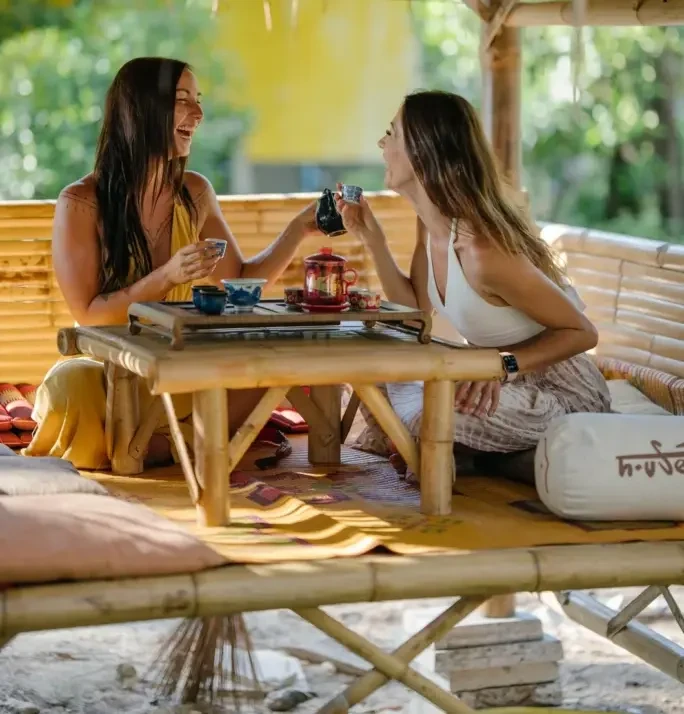
The immersion runs 10 days with 9 nights’ accommodation at the school’s beachfront resort in Koh Phangan. Confirmed inclusions:
| Confirmed included | Not specified — verify with the school |
|---|---|
| 9 nights’ accommodation | Airport or pier transfers |
| Two meals per day on training days | Meals on non-training days |
| All teaching sessions and practicum | Laundry |
| House of Om welcome bag with learning materials | Travel insurance |
| Lifetime access to the online modules | Flights and ferry tickets |
| Certificate on successful completion | Yoga Alliance registration fee |
Room options range from a training-only booking, where you arrange your own stay, through shared dorm and twin rooms to private rooms. A $500 deposit holds a place, and the school states that changing dates is free. Prices and current offers should be checked directly, since promotional pricing changes.
The two-meals-a-day detail matters for budgeting. Over 10 days that is a meal a day you are buying yourself, plus anything on non-training days.
How Certification Works — and the Question to Ask Every Hybrid School
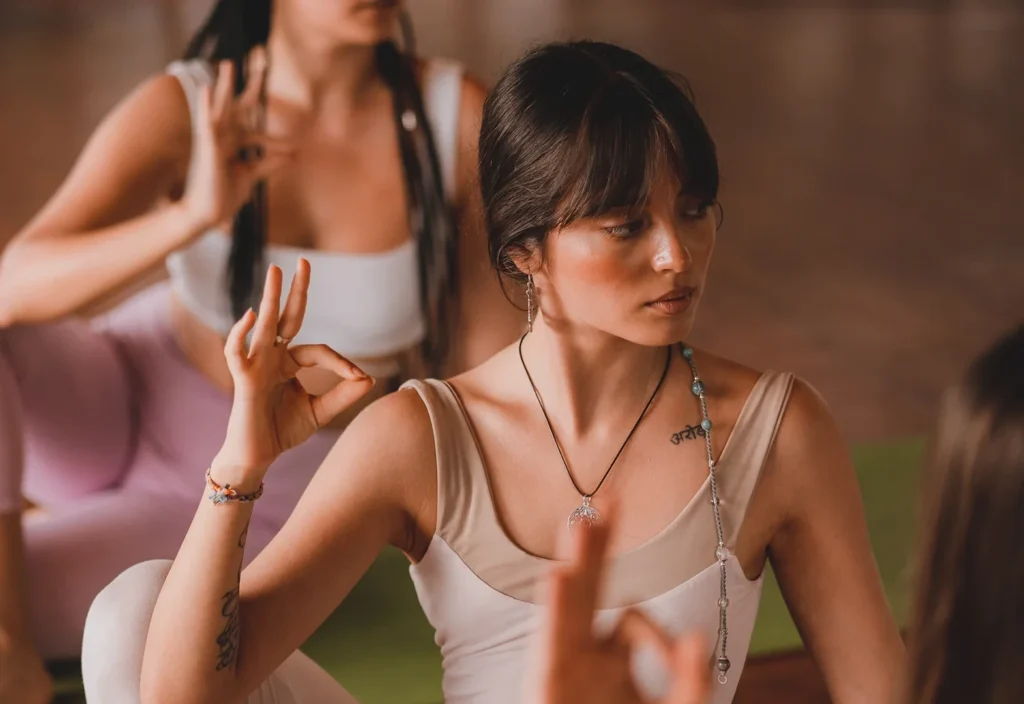
House of Om states that students who complete both the online and in-person components receive a 200-hour Yoga Alliance certificate. Certification depends on completing the requirements and passing the assessments; no school can promise it in advance.
Worth understanding clearly: the school holds Registered Yoga School status. You hold the Registered Yoga Teacher registration, which you apply for yourself after graduating and which carries an annual fee paid to Yoga Alliance rather than to the school. Registration is voluntary, though many studios and insurers ask for it.
Here is the part most hybrid comparisons miss. Yoga Alliance sets limits on how much of a 200-hour course may be delivered online. Its published RYS hours policy states that under the standards effective from 27 February 2020, all 200 hours must be classroom hours, with an option for 40 of those 200 to be delivered as online classroom hours — up to 20 in Anatomy and Physiology, and up to 20 in Yoga Humanities.
| The question to ask
Ask any hybrid school, House of Om included, how its 200 hours are allocated between online and in-person delivery, and confirm that allocation satisfies current Yoga Alliance standards for the credential you want. Schools structure hybrid programs in different ways, and this is the detail that determines whether your certificate does what you expect. Get the answer in writing before you pay a deposit. |
This is not a reason to avoid hybrid training. It is the one question a comparison-stage reader should always ask and rarely does.
Advantages of Hybrid Yoga Teacher Training
- Less time away. 10 days is achievable on standard annual leave. Three or four weeks usually is not.
- Lower total cost. Fewer nights of accommodation and a shorter trip reduce the overall spend, before you compare tuition.
- Theory at your own speed. You can rewatch an anatomy lesson four times without holding up a room.
- Arrive prepared. If you start online, the in-person days are spent applying material you already know rather than meeting it for the first time at six in the morning.
- Flexible sequencing. Being able to travel first and study later removes the deadline pressure that puts people off booking.
- Material you keep. Lifetime access means the library stays available as a reference once you start teaching.
Limitations of Hybrid Yoga Teacher Training
An honest account of the trade-offs, because they are real.
- Self-discipline is the whole game. Nobody chases you through the online modules. People who need external structure often stall.
- Less time with teachers. Ten days of contact is less than three weeks of it, whatever the hour count says. Questions you would ask in passing during a residential course have to wait for a scheduled moment.
- A shorter cohort experience. The group bond that residential trainees describe takes time to form. Ten days is enough to build something; it is less than three weeks would build.
- You still have to travel. Hybrid reduces the trip, it does not remove it. Koh Phangan has no airport, so arrival involves a ferry regardless of format.
- The transition can be jarring. Moving from unhurried self-study to ten dense days of practice is a real gear change. If you start online, keep a physical practice going in the weeks before you fly.
- Split attention. The online portion happens inside your ordinary life, with all its interruptions. Part of what a residential course buys is the absence of those.
Hybrid vs Fully Online vs Fully In-Person
| Factor | Hybrid | Fully online | Fully in-person |
|---|---|---|---|
| Theory learning | Self-paced online | Self-paced online | In the classroom |
| Practical training | Concentrated in person | Remote, often via video submission | Daily throughout |
| Face-to-face instruction | Limited to the immersion | None, or live video only | Continuous |
| Travel required | Yes, shorter trip | None | Yes, full duration |
| Flexibility | High for theory, fixed for the immersion | Highest | Lowest |
| Time away from work | Around 10 days | None | Three weeks or more |
| Teaching practice | In person, with direct feedback | Usually recorded and reviewed | In person, repeated |
| Typical cost | Between the other two | Lowest | Highest |
| Best for | Limited leave, but wants hands-on teaching practice | Travel is not possible; strong self-directed learner | Wants full immersion and continuous teacher access |
No format is better in the abstract. They solve different problems.
What to Check Before Choosing a Hybrid YTT
- How are the 200 hours split between online and in-person delivery, and does that split meet current Yoga Alliance standards?
- How many teaching practicum hours happen in person?
- Is there a deadline for completing the online portion, or is it genuinely open-ended?
- What support is available while you study online — live sessions, a mentor, or recorded material only?
- What assessments exist, when, and what happens if you do not pass first time?
- Is the school currently registered with Yoga Alliance, verified in the directory rather than taken from its website?
- Who is teaching your specific intake?
- What exactly does the accommodation package include, and what is excluded?
- What are the cancellation, rescheduling, and refund terms in writing?
- What is the group size for the immersion?
Is Hybrid Yoga Teacher Training in Thailand Right for You?
A simple way to decide:
| Your situation | Format that probably fits |
|---|---|
| You have limited leave but want real hands-on teaching practice | Hybrid |
| You can take a month off and want full immersion | Fully in-person |
| You cannot travel at all and study well independently | Fully online |
| You need external structure and deadlines to finish anything | Fully in-person |
| You want the lowest cost and are content with remote practicum | Fully online |
| You want a Thailand immersion without a month’s absence | Hybrid |
The honest test for hybrid is the fourth row. Everything else about the format is a genuine advantage, but it all depends on you finishing the online portion without anyone reminding you.
House of Om’s Hybrid Program in Koh Phangan
If the format fits, here is what House of Om’s version involves, in summary:
- A 10-day in-person immersion in Koh Phangan with 9 nights’ accommodation at a beachfront resort
- Two meals per day on training days
- A self-paced online library of 20 modules with lifetime access
- The choice of starting online or in person
- A welcome bag with learning materials
- A 200-hour certificate on completing both components and passing the assessments
- A $500 deposit to hold a place, with free date changes
Full current dates, room options, and pricing are on the hybrid program. If you would rather do the whole thing on site, the school also runs a full residential 200-hour in Koh Phangan. If travel is not possible at all, there is a fully online 200-hour as well.
A hybrid program also runs in Bali — see the Melati hybrid training — or compare all House of Om programs if you are still weighing destinations.
Frequently Asked Questions
What is hybrid yoga teacher training?
A 200-hour course split between online theory and in-person practical training. You study philosophy, anatomy, and teaching theory remotely, then attend a shorter in-person block for asana practice, hands-on adjustments, teaching practicum, and assessment.
How does hybrid yoga teacher training in Thailand work?
With House of Om, you complete a self-paced online module and a 10-day in-person immersion in Koh Phangan with 9 nights’ accommodation. You can do either component first. The certificate is issued once both are complete and the assessments are passed.
How long is the in-person portion?
Ten days, with 9 nights’ accommodation included at the beachfront resort in Koh Phangan.
Is accommodation included in hybrid yoga teacher training?
In House of Om’s program, yes — 9 nights, with room options from shared dorm to private. Two meals per day are included on training days. A training-only booking is also available if you prefer to arrange your own stay.
Can beginners join hybrid yoga teacher training?
Check each school’s entry policy, as this varies. Worth considering: a hybrid format asks you to learn the theory without a teacher present, which some complete beginners find harder than a residential course where everything is explained in the room.
Is hybrid better than fully online training?
Neither is better in general. Hybrid includes in-person teaching practice and hands-on adjustment work, which is difficult to replicate remotely. Fully online requires no travel and usually costs less. Choose based on whether you can travel and how you learn.
Does hybrid training lead to the same certification?
House of Om states that both its hybrid and full residential Thailand programs lead to a 200-hour certificate. With any school, ask how the 200 hours are divided between online and in-person delivery and confirm the split meets current Yoga Alliance standards.
Do I still need to travel for hybrid yoga teacher training?
Yes. Hybrid shortens the trip rather than removing it. For Koh Phangan, allow most of a day for the final leg, as the island has no airport and every arrival involves a ferry.