
A 200-hour yoga teacher training is the entry-level qualification for teaching yoga professionally. In Thailand, it is usually delivered as a residential course of roughly three weeks, where you live on site, practice daily, and finish with practical and theoretical exams.
This guide covers what those three weeks actually involve: the curriculum, the daily rhythm, the exam, what is included, and what to work out before you book. The 200-hour yoga teacher training in Koh Phangan run by House of Om follows that format, and it is used throughout as a worked example.
What Is a 200-Hour Yoga Teacher Training?
The 200-hour is the foundation credential in yoga teaching. Complete one at a school registered with Yoga Alliance, and you become eligible to register yourself as an RYT 200 — Registered Yoga Teacher.
One distinction catches people out constantly: the school holds the RYS registration; you hold the RYT registration. You apply for it yourself after graduating, and it carries an annual fee paid to Yoga Alliance rather than to the school. Registration is also voluntary. Yoga Alliance is a registry, not a licensing body, so you can teach without it in most places — though many studios and insurers ask for it.
The 200 hours are not left to each school’s discretion. Under the standards Yoga Alliance introduced in 2020, they break down like this:
| Category | Required hours |
|---|---|
| Techniques, Training and Practice | 75 |
| Anatomy and Physiology | 30 |
| Yoga Humanities | 30 |
| Professional Essentials | 50 |
| School’s allocation | 15 |
Keep that table when you compare schools. If a published syllabus gives eight hours to anatomy, either there are unlisted hours elsewhere, or it is not meeting the standard. Ask. For a full breakdown of what the 200-hour curriculum contains, we have covered each category separately.
What the Training Includes
Beyond the asana most people picture, a full 200-hour covers:
- Alignment and adjustment — understanding how poses work and learning safe, effective hands-on adjustment
- Functional anatomy — enough to teach without causing injury, including injury-prevention biomechanics
- Pranayama — breath techniques and their effects
- Meditation — developing your own practice and learning to guide others
- Yoga philosophy — the tradition beyond the physical practice
- Teaching methodology — sequencing, cueing, class planning, reading a room
- Practicum — teaching real people and receiving structured feedback
House of Om’s Thailand program adds a set of elements many 200-hour courses skip: shatkarma (yogic cleansing), mantra and meditation, Yoga Nidra, Ayurveda, kirtan, sound healing, and Voice Activation.
That last one is worth pausing on. Voice Activation is dedicated training in using your voice with clarity and intention — projection, communication, teaching presence. Most new teachers know their sequences perfectly and then discover, three minutes into a real class, that they cannot be heard at the back and cannot pace a cue to a breath. Very few 200-hour curricula train this formally, and it is the skill new teachers most often say they wish they had.
How the Course Is Structured
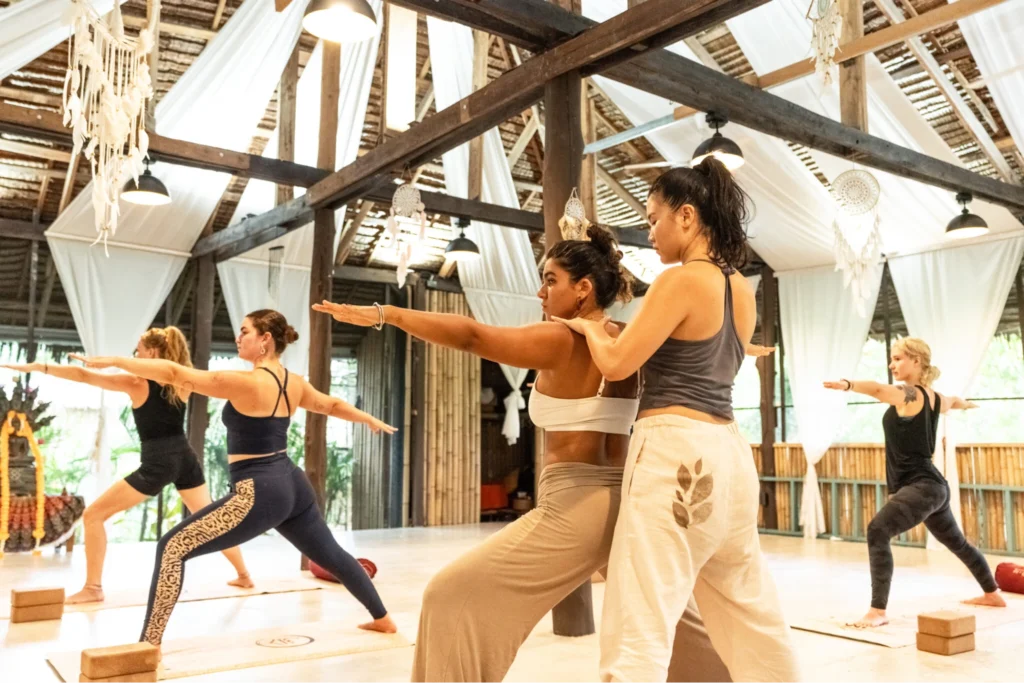
House of Om organizes the Thailand training by style, one per week:
| Stage | Focus |
|---|---|
| Week 1 | Hatha yoga |
| Week 2 | Vinyasa flow |
| Week 3 | Introduction to Ashtanga |
| End of course | Practical and theoretical examinations |
This is a sensible order rather than an arbitrary one. Hatha works pose by pose, holding shapes long enough to understand them. Vinyasa links those shapes to breath and movement. Ashtanga applies both to a set, demanding sequence. Learning them in that order means each week builds on the last, rather than asking you to flow through poses you have not yet dissected.
Hatha, Vinyasa and Ashtanga: what is the difference?
| Style | Pace | What it teaches you as a teacher |
|---|---|---|
| Hatha | Slow, held postures | Precise alignment; how a pose is built |
| Vinyasa | Continuous, breath-linked | Sequencing and class arc; how to build flow |
| Ashtanga | Set, vigorous sequence | Discipline, progression, working within a fixed system |
House of Om describes the training as rooted in Hatha and Vinyasa Flow, with elements of Ashtanga to deepen practice. That is an accurate framing, and it is worth taking at face value: three weeks gives you a working foundation in each, not mastery of any. Anyone promising expertise in multiple styles inside 200 hours is overselling.
What a Training Day Looks Like
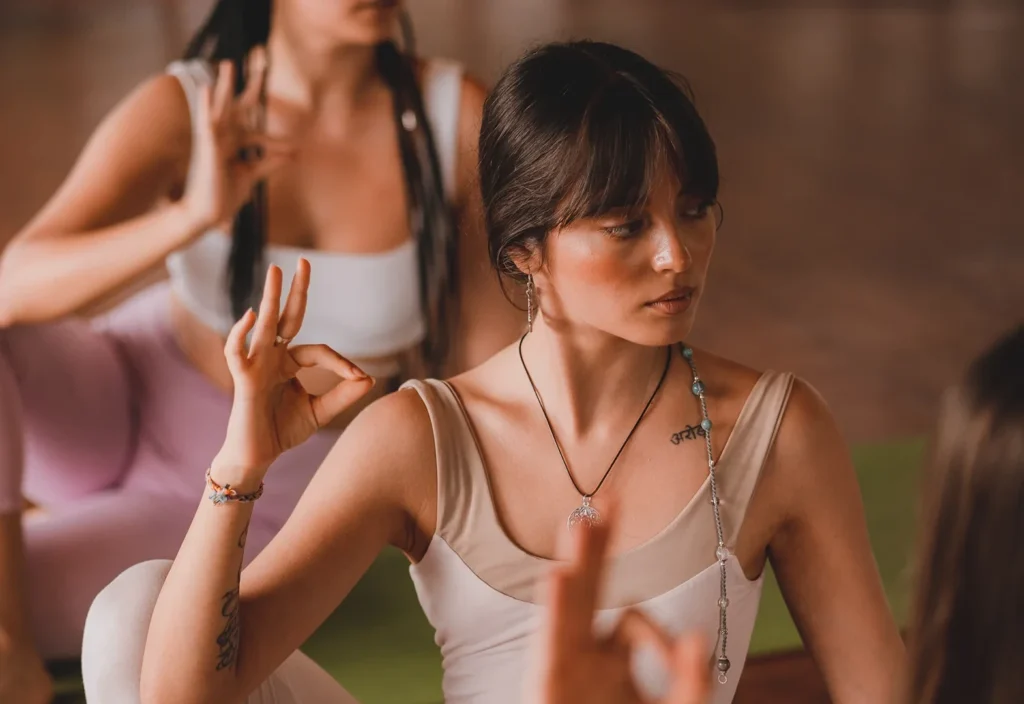
House of Om publishes this schedule for the Thailand course:
| Time | Session |
|---|---|
| 06:00 – 06:15 | Shatkarma |
| 06:15 – 06:30 | Chanting |
| 06:30 – 07:45 | Asana and pranayama |
| 08:00 – 08:45 | Morning lab |
| 08:45 – 10:00 | Breakfast |
| 10:00 – 12:30 | Jnana yoga |
| 12:00 – 13:15 | Yoga Nidra |
| 13:15 – 14:30 | Lunch |
| 14:30 – 15:30 | Teaching methodology |
| 15:30 – 16:45 | Alignment and adjustment |
| 17:00 – 18:00 | Evening sadhana |
The school notes that the daily schedule is subject to change at the teacher’s discretion.
Each day has a clear rhythm, beginning before six and winding down around six in the evening. Study, practice, and teaching are woven together throughout the day rather than kept in separate blocks. Practice happens twice — sunrise asana and evening sadhana — with the theoretical and teaching work in between, when you are awake enough to absorb it.
The honest part: this is a course, not a holiday. Expect around eight hours of structured learning each day, plus time to prepare for your teaching practicum. For many students, week one feels exhilarating, week two asks a little more of you, and week three brings a sense of clarity and confidence. That rhythm is completely normal, and a good school should be honest about the experience before you arrive.
Yoga Alliance Certification: What You Actually Get
On successful completion of the practical and theoretical exams, House of Om graduates earn a 200-hour certificate, enabling them to register with Yoga Alliance as an RYT-200. This is an internationally recognized credential for yoga teachers.
Two things to be clear about.
Certification depends on completing the requirements. Passing the asessments and exams are part of the certification process, so certification cannot be guaranteed in advance.
Recognition is not the same as a licence. The RYT-200 is a professional credential, not a work licence. It is widely accepted by yoga studios, gyms, and retreat centres internationally. It is not a work permit, and it does not override local employment rules in any given country.
Before booking any school anywhere, verify its current RYS status directly in the Yoga Alliance directory. Also worth checking there: Yoga Alliance requires every RYS 200 Lead Trainer to hold the E-RYT 500 credential, and it publishes a public Overall School Rating for each registered school, fed by reviews graduates must submit before completing their own registration. House of Om’s rating is 4.66 out of 5.
Where You Stay
The Thailand training is based at a beachfront resort on Koh Phangan, with 19 nights’ accommodation included. Six options are available, and the training itself is identical across all of them — you are choosing sleep and privacy, not curriculum.
| Option | Configuration | Standard | Early bird |
|---|---|---|---|
| Training Only | Arrange your own stay; resort facilities included | $1,955 | $1,615 |
| Dorm Deluxe | 4 beds, shared bathroom | $2,875 | $2,320 |
| Twin Room | Female-only, 2 single beds, shared bathroom | $3,220 | $2,660 |
| Private Cozy | 1 single bed, private bathroom | $3,795 | $3,135 |
| Private Room | Private bathroom | $4,025 | $3,230 |
| Private Deluxe | Queen bed, spacious, private bathroom | $4,375 | $3,515 |
Prices as displayed on the House of Om Thailand page, including a 15% early-bird offer. Confirm current pricing before booking.
Which to choose is a real decision, not a budget footnote. Three weeks of six-o’clock starts is different in a dorm than in a private room. Shared rooms build the cohort bonds people remember years later; private rooms let you decompress when the emotional load lands. If you know you need solitude to process, pay for it. If you know you will isolate when things get hard, do not. For a wider view of what trainings cost across formats and countries, see our 2026 price guide for yoga teacher training.
The Training Only option is the outlier — it covers the full program and resort facilities but leaves accommodation to you. That suits someone already living on the island, or travelling with a partner who is not training.
Meals
House of Om provides fresh vegetarian meals, Ayurvedic-inspired and prepared with organic ingredients, described as supporting students through the training.
Practical note: three weeks of vegetarian food is a bigger adjustment than most people expect if it is not already your diet. It is rarely a problem, but it is worth knowing rather than discovering. If you have allergies or specific dietary requirements, raise them at the enquiry stage — not on arrival.
Who Can Join

Beginners are welcome. However, having at least six months of consistent yoga practice can make the training easier to navigate, giving you a foundation in the postures, practice, and rhythm of yoga before you begin.
Crucially, you do not need teaching ambitions to enrol. The school notes that many students join to deepen a personal practice, reconnect with themselves, or explore yoga more seriously — with no plan to teach at all. If that is you, a 200-hour is a legitimate choice, not a misuse of one.
Can beginners really do this?
Yes — but eligible and ready are not quite the same thing.
There is no minimum practice requirement here. What a few months of regular practice buys you is bandwidth. Training moves fast, and if you are still translating “externally rotate the femur” in your own body, you will spend the anatomy module decoding instead of absorbing. That is not a barrier; it is a reason to practice a little beforehand if you can.
Flexibility is not the point and is not assessed. You are learning to instruct safely and adapt for different bodies. Trainees with limited range of motion often make better beginner teachers, because they have had to solve problems naturally flexible practitioners never encounter.
Why Koh Phangan?
Koh Phangan has a long-established reputation as a centre for yoga and wellness in Thailand, alongside its better-known nightlife. Condé Nast Traveler readers voted it the third best island in Asia in the magazine’s 2020 Readers’ Choice Awards — worth knowing, and worth noting the date.
A substantial part of the island is protected within Than Sadet–Ko Pha-ngan National Park, established by royal decree in November 2018, covering forest, waterfalls, and coastline. The practical effect is that development is constrained and large stretches of the island remain undeveloped.
House of Om’s location is beachfront, with direct access to the sand.
Getting there: plan this properly
Koh Phangan has no airport. Every arrival involves a ferry. The usual routes are:
- Fly to Koh Samui (USM) — shortest hop, most expensive flights
- Fly to Surat Thani (URT) on the mainland — cheaper, longer transfer, then bus and ferry
- Fly to Nakhon Si Thammarat (NST) — cheapest, longest
Budget most of a day for the final leg, and do not book a flight arriving late on the day your course starts. Ferries stop running in the evening, and missing the last one means an unplanned night on Samui.
Weather: the thing most guides get wrong
Koh Phangan sits in the Gulf of Thailand, not the Andaman Sea, and its rainy season runs on a different calendar from Phuket’s. Thailand’s National Climate Center notes that the northeast monsoon, which begins in mid-October, brings abundant rain along the eastern coast of the southern region — precisely when many people assume they are booking dry-season travel, because that is the pattern on Thailand’s west coast.
This matters if you are eyeing the late-year dates. Training continues regardless, and the island is greener and quieter then. But pack for rain, and do not plan the trip on Phuket’s weather chart.
What to Prepare
Practically:
- Two to three sets of practice clothes — laundry access is easier than a big suitcase
- A notebook. You will write more than you expect
- Reef-safe sunscreen and insect repellent
- Travel insurance that covers course fees, not just medical costs
- Confirm current Thai entry requirements with official sources before you fly; visa rules change
House of Om provides a welcome bag containing training materials, a neti pot, a mala bead, and a sarong — so those do not need packing.
Mentally, and this is where people go wrong:
Arrange your time off properly. Trying to work remotely through a residential training tends to mean doing both badly.
Do not cram the free time. Rest days exist because the schedule is demanding. Filling every one with island excursions is the fastest route to burning out in week three.
Do not arrive expecting the course to resolve something personal. It is an education program. Many people do find it clarifying, but that is a side effect rather than the design.
What the Experience Is Actually Like
The parts nobody puts in the brochure:
The middle is the hard part. Week one carries novelty. Week three carries the finish line. Week two is where the early starts accumulate and the practicum starts feeling real. Knowing that in advance makes it easier to sit with.
Your practicum will feel worse than it is. Everyone’s first taught class is stiff. That is what the feedback is for.
The cohort matters more than you would guess. Twenty-odd people going through the same demanding three weeks in an unfamiliar place tend to become close quickly.
You will be tired in a way that is unfamiliar. Not gym-tired. It is the combination of physical practice, sustained concentration, and processing a lot at once.
Full Training or Hybrid?
House of Om runs a separate Hybrid 200-hour training on Koh Phangan. It is a genuinely different product, not a discount version.
| Full 200-Hour | Hybrid 200-Hour | |
|---|---|---|
| In person | Roughly three weeks | 10 days |
| Accommodation | 19 nights | 9 nights |
| Theory | On site | Self-paced online, before or after |
| From | $1,615 early bird | $1,045 early bird |
| Certificate | 200-hour Yoga Alliance certification | 200-hour Yoga Alliance certification |
The certificate is the same either way. The difference is scheduling and immersion, not standard. The full training gives you three uninterrupted weeks; the hybrid suits anyone who cannot take a month off or prefers to work through theory at their own pace.
Questions to Ask Before You Book
- What is the group cap for my specific intake?
- Who is the lead trainer, and can I verify their E-RYT 500 credential in the Yoga Alliance directory?
- What happens if I get ill and miss sessions — how are hours made up?
- Which meals are included, and on which days?
- Is the early-bird price still live for the date I want?
- What exactly does my accommodation option include?
On booking terms specifically: House of Om takes a $500 deposit to hold a place and states that changing dates is free. Paying tuition in full adds lifetime access to its online 200-hour library — recorded lessons, teaching resources, templates, and downloadable materials. Note that this bonus attaches to paying in full, not to every payment option. For exact terms, read the school’s Terms & Conditions page.
Frequently Asked Questions
How long is a 200-hour yoga teacher training in Thailand?
Most residential programs run around three weeks. House of Om’s Thailand course includes 19 nights’ accommodation at a beachfront resort on Koh Phangan.
Can a complete beginner do a 200-hour YTT?
Yes. House of Om states that all levels are welcome, including complete beginners, and that students do not need teaching ambitions to join. Though at least 6 months of consistent practice will make the course easier.
Some enrol purely to deepen a personal practice.
What styles are taught in the training?
Hatha in week one, Vinyasa in week two, and Ashtanga alongside teaching methodology in week three. The training is rooted in Hatha and Vinyasa, with Ashtanga elements to deepen practice.
What certification do graduates receive?
Students sit practical and theoretical exams at the end of the training. On successful completion, graduates earn a Yoga Alliance certification, which House of Om describes as internationally recognized.
Do I have to register with Yoga Alliance after graduating?
No. Registration is voluntary and carries an annual fee paid to Yoga Alliance, not the school. Many studios and insurers ask for it, so most new teachers register at least initially.
Is Thailand a good place for yoga teacher training?
It is well established for it. Koh Phangan specifically combines a long-standing yoga community with a protected natural environment. The practical trade-off is transfer time — there is no airport, so every arrival involves a ferry.
What should I bring to yoga teacher training?
Two or three sets of practice clothes, a notebook, reef-safe sunscreen, insect repellent, and travel insurance covering course fees. House of Om supplies training materials, a neti pot, a mala bead, and a sarong in its welcome bag.
What is the difference between the full and hybrid Thailand programs?
The full training is a longer in-person immersion with 19 nights included. The hybrid is 10 days in person with 9 nights, plus self-paced online theory. Both lead to the same 200-hour certification.
When to Go
House of Om runs the Thailand training on a rolling schedule, with intakes listed through late 2027. Popular dates fill first, so three to six months’ lead time is sensible — and it also gives you room to build up a regular practice before you arrive.
See current dates and pricing for the Koh Phangan training, or browse all House of Om programs across Thailand, Bali, India, and online.